Handoff Record
Handoff Record
September 10–13
New analytical exploration: X-027 connects the Stromquist correspondence with the recent certificate and owner results. Three cross-reviewed reports derive the full-unit fractional obstruction at , a precise interior-duality argument, seven-of-eight corner-mark ownership, and at most three normalized physical contact components. A floor-charge example adds an exact abstract expressiveness separation. These are analytical deductions with explicit scope, not newly registered frontier results or target measurements. BC329 remains the direct-bound continuation; small geometric charge and joint-owner tests are the next new mechanism comparisons. X-027’s ranked table states their prerequisites and what each outcome would establish. The exploration and all three reports now define their terminology locally, use KaTeX notation, and identify their imported premises and supplied results. Session126 retains the analytical work, independent reviews, and validation.
Weighted atoms now exist in production:
Session127
implemented the representation and source replay from the first two stages of the
weighted-atom admission.
Its
review addendum
records the consumer corrections and the remaining validation boundary.
ThresholdAtom carries an explicit positive integer token count per distinct site.
Geometry uses one membership rectangle per site; the threshold and resource budget count
tokens. For total token count , threshold , and nonnegative atom weight , the
budget is . The D4 orbit key preserves each site’s count, and the
inclusion–exclusion expansion runs over labelled tokens.
The retained seven-token, threshold-four motif expands over 64 token
subsets with absolute coefficient mass 209, where the same atom read as five sites
reports 9, so the int64 headroom bound now reads the token count.
All four retained receipts reproduce their declared token total, budget, charge
and exact charged-placement lists from family geometry, on rational coordinates up to
965 characters wide.
Replay digests bind the supplied inputs; no retained historical digest authenticates
their pairing. Unweighted admission and publication readers refuse declared weighted
records. The internal interval route supports weighted member counts within its size
limits; that support does not admit certificate coverage.
No hypothesis, experiment or scientific target was registered or run, and the frontier
is unchanged.
Selected next entry at that cutoff: think-8c9e, the weighted-atom coverage
mechanics. The agreeing direct, event and interval controls on weighted atoms remain,
including the closed-boundary and undercharged-core cases and the interval route’s stall
handling, which is unresolved rather than a refuted atom or a failed budget proof.
Certificate coverage admission stays blocked until they pass, and the paired instrument
with its exact common row and point manifests is tracked separately behind it.
The parallel BC329 lane has completed its bounded fixed-core runner implementation
review in PR156. Its separate calibration instrument, three fresh full-shape host runs
and source-distinct readbacks remain unadmitted and unrun, so BC329 execution remains
blocked. The
preflight addendum
records the implemented controls and the remaining admission requirements.
Current combined reader entry:
the consolidated PR-series takeaways,
with definitions, proof results, scoped negatives and open comparisons in one place.
PR137, PR142, PR145 and PR147 landed together at 1c1db463 on September 10, 2026. PR139
then merged as 3a18a05a, incorporating that owner strand and contributing T-024–T-026.
At that cutoff the global lower bound was ; the upper construction is
unchanged at . The review corrections preserve the fixed-family scope
of conditional obstructions and the existential owner-selection requirement.
Finite support, net and grid results do not close entire research directions.
The
review addendum
and PR139 carry finalization evidence.
The post-merge daytime checkpoint adds no new global bound or target measurement.
It proves that the translated 88-core obstruction has exact, zero-mismatch individual
unit parents from , and independently verifies the analogous A6 statement from
; contact, ownership and joint feasibility remain separate conditions.
It also retains the fixed-angle adjacent-wall contact normal form, the correction that
an arbitrary tight SAT row need not be physical contact, and the abstract
weighted-atom separation.
The parent-domain adapter and production runner passed target-free independent
admission, including deadline, timeout, failed-readback and source-closure adversaries.
Exp156 then completed its sole source-bound run.
The fixed exp151 residual lies inside its necessary parent box, while the first selected
owner, TR / bottom-left:m1:j7, is already incompatible under the B-only model after
all 181 frames and literal replay.
The parent-restricted TR set is contained in that B-only set, so parent-domain gain is
impossible there without running the redundant restricted arm.
The frozen protocol did not evaluate BL, BR or TL; a new prospective protocol
would need to skip TR and test those three owners.
This complete old-model finding leaves H-158 unresolved and changes no global bound.
BC329 remains the next direct global-bound target.
BC337 is a secondary parallel lane, blocked on admission of a source-bound half-plane
constructor, exact clipping, bounded runner and independent reader.
It keeps exp151 direction 6 and open residual-centre domain . The control
uses the existing TR centre-space obstacle with the same nine other
closed obstacles; the candidate substitutes the exact all-owner-incompatible obstacle
directly, with no second Minkowski expansion.
Thus U0 and U1 remove the respective TR obstacles and the same other nine obstacles
from open . The target would accept only exact area(U1) = 0 with
independent union confirmation; because U1 remains open, that establishes emptiness.
The strategy review
puts the conditional parent comparison first and one frozen 2880-step core/net packet
next, while multiplicity admission, contact-conditioned domains and mixed angle-profile
charges proceed as separate blocks.
The packet’s
target-free preflight
verifies its exact geometric headroom but identifies two prerequisites: test the raw
least charge against , then normalize by the frozen rule
; and admit a bounded fixed-core runner because the existing refinement
CLI runs a different adaptive experiment.
Coverage remains unmeasured, so this is a readiness result rather than a new bound.
The two-attainer target remains preparation.
Historical handoffs below retain their original context.
Session113
closed Agenda032 with T-023, the five-dot exclusion of
one specified four-owner branch at side . The composed result is V3/C3,
significance S3: exact full-net coverage plus audited geometric transfer, with no change
to the global bound.
The
sprint report
explains the full result and next think-yhw2 selection.
The
gaps and routes analysis
separates certificate assurance, exhaustive case coverage and stronger geometric
restrictions, including what could improve the bound at a different target side.
Agenda033 governs the continuation after T-023. Exp145 independently confirmed all 361 exact zero deficits in 39.06 seconds. Exp146 then completed all 16 wall-aware owner classes in 25.69 seconds: 12 common footprints strictly enlarged, four were equal and none was impossible. H-144 is accepted, but that geometric gain adds no owner selection or global lower bound by itself.
Exp147 completed its bounded component-containment transfer: eight of 128 relations held, it preserved the two baseline tuple labels, and it certified no additional selection. This is a negative result for that sufficient transfer, not a physical tuple census. PR142 retains the independently tallied audit and wall-aware continuation. The owner-case design shows why proper containment cannot extend the equal-area coarse patch family; simultaneous square symmetries give only two geometric owner tuples. No shared arrangement census has been promoted from this result. Usage after Session113 is retained in separate, nonoverlapping receipts.
Math startup release checkpoint.
Session 111
records the prepared geometry, parameter-first hydration, reload restoration, and the
local browser and PDF evidence for PR 135.
PR 135 subsequently landed on main at 171bba33; its post-merge CI, Pages deployment,
live publication checks, and delayed-font smoke test passed, closing the release work
under think-qcmi. The research priorities below are unchanged.
Parallel structural lanes at , first wave terminal.
X-021
pursued X-019’s exploration with four Fable lanes in parallel and reports what can be
proved about eleven-square packings today: seven corner and wall lemmas, exact-verified
angle counts at on the rational cell unions specified in H-131 (rounded degree
labels are approximations, not theorem endpoints), Stromquist’s Theorem 3 transported to
bands at , the spanning and chain lemmas, a weighted ownership
lemma that would make four-corner containment a theorem from one LP, and a duality lemma
that prices every conditional and capture certificate — including a retained-net cap
below with the strict endpoint corrected in the handoff review.
It also records what cannot be forced (corner penetration, blocker angles,
positive-length contacts, a bound on orientation classes) and prices the three closing
architectures.
Agenda 030,
epic think-kbci, maps eleven research lanes with disjoint deliverables under
BC-292–BC-302. BC-303 selected the continuation and BC-304 has dispositioned every lane,
including the unmet scopes inherited from Agenda 029. H-127–H-134 register the lanes’
claims. The lane reports and every script they ran are retained under
results/agenda-030/.
No bound has changed.
The owner started the wave on 2026-09-08: sessions 100 to 104 run BC-294 (the
value and the kill tests), BC-293 (the corner-skeleton measure), BC-295 (the band replay
and widening), BC-297 (the plateau) and BC-302 (the eleven-mark ownership set),
each in its own worktree on claude/squares-n11-constraints-wl9atd; exp-130 was the
next experiment id at launch.
Session-103
is the first terminal lane: the exactly-eleven plateau at is not a Trump-strip
artefact (45 grid-seed sites and 822 of BC-200’s retained sites lie in two or more of
the scaled cores), the general site-invisible-overlap mechanism holds, adding strip
sites left the value at with the generator stopping on its 32-row pricing cap,
and an exact census at the different mass exceeds one million near-tight
cells with no clustering on Trump’s cores.
This rejects the proposed strip explanation; it does not prove an obstruction at mass
eleven or decide full-dual pricing.
Session-102
replayed every count in H-131 exactly and widened the robust end band far past H-130’s
: no packing at has every folded angle in Theorem C’s exact end-cell
union (degree boundaries approximately and )
(Theorem C, grid 119, mass ), with
the first rung on grid
79; the dual of the band toward puts its weight near the axis, not at
Trump’s angle, and ceiling.py decides that none of those duals is a continuum
obstruction, so the band’s true value stays open from below.
Session-104 met
H-134 in segment form: ten horizontal segments of length centred on Stromquist’s
ten Figure-13 points at are a robust unavoidable set at tolerance ,
certified by an interval reader over pose space with every one of its 184,756 leaves
re-decided in exact arithmetic, while every point-mark set built from the atom skeleton
has an exact escape; every contained unit square is therefore localised near one of ten
known segments, which is the premise route (a) needed, though not exactly-one ownership.
Session-101
found H-128 unsuccessful on its tested finite support at : the corner-bounded
measure sweeps exactly at mass against free, and the corner atom’s
position, not the bound, is the obstacle on that support.
H-128 remains open over the retained net; it proved the corner-pair form instead, that
every packing at has four distinct squares each containing one of its corner’s
two marks, so the anchor for BC-299 is a corner pair.
Session-100
left H-129 undecided: the family at verifies exactly at on a
203-direction net, with its weight diffuse in angle and mostly outside Trump’s
neighbourhood. The handoff review found a stronger retained control: exp-070’s family
transports by to unit squares at side , preserving
depth one and mass . A smaller feasible family
does not certify an upper bound.
The depth polisher will start from that retained control; its missing scratch state is
not a runnable handoff.
Session117 completed exp147’s bounded containment screen under H-145. All 128 relations completed; the screen preserved only the two baseline labels and added none.
BC-319 then ran under think-ykd6, with
exp-148
registered under H-146. It keeps the five dots fixed, builds a reusable exact witness
bank, and permits one surviving tuple check.
Exp148 retained two exact witnesses before its seed deadline: 49,152 labels rejected,
16,382 nonbaseline labels remaining, no candidate attempted.
H-146 remains unresolved.
Session120 continues the published work from Session119. Exp-148 was partial. The separate analytic transport rejects 61,440 labels for fixed D, leaving 4,094 nonbaseline labels. Exp-149 refutes H-147 at its first required direction: owner-000 has a positive exact uncovered area and a retained rational strict escape for the selected four-patch relaxation labelled by tuple . This refutes fixed D as a cover of that relaxation, not the physical tuple. H-146 remains unresolved over other labels.
BC-320 then tested the saved escape and every one-site extension of fixed D on that same
relaxation. Current evidence:
exp-150
refuted individual-owner exclusion in the unchanged B-core model, with one frame-0
witness in each of four classes;
exp-151
refuted the fixed sixth site;
exp-152
accepted the necessary two-core screen;
exp-153
is the completed refutation of every one-site extension of fixed D on the selected
four-patch relaxation.
exp-154
refuted H-157: six of its eight refined subclasses retain survivor weight ten, while
two improve to . The two improved patches intersect their fixed target cores, so
their old positive distance explanation was invalid; the six neutral children retain the
reported positive distance.
The corrected T1 and T2 statements concern the retained finite ray universe and the
fixed patch-only residual domain.
They do not rule out other angular restrictions, stronger domains, changed charges, or
owner-selection routing, and they do not establish that the conditional strategy fails.
Separately, the retrospective
BC303 T1 literal replay
rejects the named bottom-left role-C universal local surplus inequality: one admissible
parent has closed labels and surplus .
It decides no continuous-domain minimum, T2 forced-type case, global routing, or new
bound. Exp150’s compatibility result does not establish continuous unit parents
or simultaneous owners, and exp153 does not exclude the physical tuple.
Session121 and Session122 are terminal. Session123 is terminal. Session124 resumed at 2026-09-10 01:52:40 UTC after the elapsed interruption. Its interpretation work and the BC-324 audit were subsequently completed and merged through PR139.
Historical interpretation selection: think-rm3k, BC-324, is complete.
That factual block defined the terms used in the argument, separated exact computations
from analytic implications, and audited the premises still required for a global result.
The key routing obligation is
The record does not prove this statement.
A reviewed two-attainer instrument is source ready but unrun; any future target needs a
separate prospective registration and allocation.
PR145 is ready after matching fast, page and full checkpoint validation.
Historical status at that checkpoint: PR142 and PR137 were ready and unmerged.
Both later landed with PR145/147 at 1c1db463.
The two-hour sprint in
Agenda032 is
complete. Exp141 independently confirmed the retained-family negative screens; exp142
completed the one-owner numerical comparison; exp143 found the four-owner five-dot
candidate; exp144 checked those unchanged dots on all 361 canonical orientations.
The footprint-containment and strict-core arguments supply the physical implication
recorded as T-023. BC-316 subsequently completed the independent polygon-union audit in
exp-145:
all 361 exact deficits were zero.
The
saved-escape decision tree
is now a historical decision record: exp150 took its compatible-owner branch, exp151
tested the selected sixth site, and exp153 closed the broader fixed-D-plus-one-site
family on the relaxation.
A global exclusion does not require every raw tuple label to be excluded.
It requires the existential owner-selection routing statement above for every
hypothetical physical packing.
Any next experiment requires a fresh hypothesis or explicitly scoped successor,
prospective criteria, published source, and a separate session usage interval.
The figure and T-023 registration are post-sprint documentation amendments and are not
charged into the frozen session113 receipt through 2026-09-09T05:16:31Z. The separate
post-sprint usage delta was initially refused for non-monotone wait timing.
The repaired meter retains that tail separately through 07:05:32 UTC, followed by
Session114’s separate receipt through 07:53:52 UTC. The original Session113 receipt is
unchanged.
PR137, on
codex/n11-ownership-continuation, is ready for review and targets main. PR142 stacks
the independent audit and overnight continuation on that milestone.
PRs 116, 121 and 127 have merged; PR127 merged as 6aa9e72c.
Session112
retains the earlier research continuation through 03:18:37Z; main’s independent font
session111 retains its own identifier and receipt.
Session110 and
the handoff review
preserve the original stack review and its separately tallied cost.
Full-support pricing H-135 remains an unrun reserve under think-7lp3. Exp134’s exact
transport control passed with depth one and unchanged mass in
135.91 seconds, but the pricing target was never invoked.
Neither that administrative stop nor the deferred H-125 kernel is a negative scientific
result. The owner-case continuation above takes priority.
Agenda 028’s restricted-family results. Session 092 and session 098 retain the independently reviewed work published on PR 110. The accepted results include the guarded central-parent exclusion, the signed short-slide exclusions, partial full-angle exclusions, exact counterexamples to the proposed disk and octagon capacity-six shortcuts, and the ten-square residual skeleton’s exact translation-fiber reduction. They apply only under their declared wall, contact, angle, or skeleton conditions and do not change the global bracket. The matched H-118 coupled-LP comparison and H-120 residual-family determination remain open, and Agenda 028 stays paused. Its dated strategy review records the evidence available before Agenda 030; the current selection above governs new work.
Agenda 030’s selection, made. Session-107 replayed the first wave’s three strongest claims with readers written from their statements, and all three agree: the segment cover at , the corner-pair containment theorem, and the band exclusion at grid 119. Two corrections came with it: the segment length threshold is in , and the cover’s certified domain now closes a far-wall sliver. BC-303 funds the segment cover toward an ownership argument as the next sustained block, with the depth polisher as the efficiency block and the plateau’s full-dual pricing as its first task; it retains the band ladder as filler and defers the corner-pair anchored certificate until the restricted fractional packing value is measured, since X-021’s duality lemma bounds any conditional certificate by it. Two more lanes ran and were halted by an external usage limit with their mathematics written and their validation unreached at that handoff: session-108 proves the grazing localisation of the escape class and records where exactly-one ownership fails (a segment can be shared, even by separated squares), and session-109 bounds the corner class’s surplus exactly at 1.6 to 1.8 per cent of the gap to the certificate line on its tested support. Its ratio optimum equals one on site set A; mark banking only proves an upper bound of one on other supports. Ratio and slice forms have the same exclusion power. Run 4 remained partial and run 5 never ran. The review also retracts lane E’s rounded-cover and enlargement helper claims while independently confirming E.4. BC-304 now closes the handoff before the funded continuation, as the owner requested. The same block repaired the deferred checkpoint (a third label-gated job for the slow behavioural lane and a declared budget for the escape screen) and amended OR-2, OR-3 and OR-6.
Atlas expansion to , owner-directed, beside the research line.
The plan under
epic think-0juv and
session-099
widened the frontier register and the known-best atlas from to
, the end of the catalogue’s audited range, on
PR 111. The unseen-corpus baseline is
commit 6e21c4ca; the calibration-only layers stay pinned to the first hundred.
The known-best-1-324 poster ships beside the untouched 1-100 figure, the prospective
seed is retired to a pointer, and the sweeps tier is re-priced from measurement with two
deferred steps.
PR 111 landed on main at 28696526. The exact grid replay is also priced
and deferred, with sampled replay retained on every pull request.
The plan still records owner questions about the derived-facts retention route (D2)
for the 123 catalogue cases, a caveated extension, and a 2x poster
raster; merging this research line does not answer those questions or authorize an
extension. PR 116 must obtain its own matching fast and deferred coverage after
integration. This line does not preempt the research selection below.
Focused parallel strategy prepared.
X-018
reviews PR108 and ranks the overnight opportunities: direct compatibility and complete
restricted-family domains first, a bounded contact-release investigation alongside them,
and shared-anchor correlation only on a diagnosed residual.
Agenda 028
owns H-118–121 and BC-269–275 under epic think-pxv5; it preserves the X-017 allocation
below and consumes its single BC-261 geometry interface.
Both proposed agendas are paused, with no new target run launched by this planning.
The live task Squares plan X-016 continues the source H-110 and conditional
compatibility allocation independently; session-091 is already occupied there.
Independent alternative prepared.
X-017
reconciles the contributed research packet with PR105’s committed state at 46f38ab4.
Agenda 027
proposes resource-and-anchor and six-plus-five restricted-family pilots, with a separate
pair-kernel discriminator.
It is paused, with no target experiments launched.
Its X-017, H-111–117 and BC-258–268 records and epic think-sz5t keep its ownership and
numbering separate from the continuing agenda below.
None of its dependencies requires that run to finish; the original handoff remains the
entry for that run.
The next research phases run in PR101 on
codex/post-381-next-phases, with the landed PR100 depth fixes and PR98 validation
improvements integrated.
Session 089
records live assignments and checkpoints; it was renamed from the branch-local
session-088 to preserve the separate landed efficiency session below.
Coordinator think-jgnv owns the integrated research line and its first two-hour
checkpoint.
Source controls have passed; independent review and bounded end-to-end target
work remain distinct.
Supporting fixes stay on this PR.
Efficiency implementation checkpoint.
Session 088
records the bounded W5 slice: detailed timing artifacts, two independently guarded
component optimizations, configuration-selection repairs, and integrated fast validation
on main edccf294 plus the reviewed changes.
Its 62 selected steps passed in 232.89 seconds on the recorded ten-CPU local host with
two outer/two inner workers; this is a dated local measurement.
PR98 retains the later hosted results and
the checkpoint status as upstream work is integrated.
The
W5 plan
links the measured results, retained profile, complete project documentation matrix, and
upstream tbd proposal.
Automatic exhaustive selection and evidence reuse remain planned.
Research continuation. The
T+2-to-T+10 continuation addendum
is the cold-review entry point for the partially completed post-T+2 continuation.
The
Agenda 024 allocation
owns prospective priorities.
Its planning block BC-250 links the
tbd assessment
of both prior reviews, and distills their directions into H-093–103 and the existing
agendas. Coordinator think-jgnv next dispatches scalar BC-251, adaptive controls
BC-231, density support BC-254, and restricted assessment BC-255 as capacity and their
readiness conditions permit.
The addendum owns command custody and recovery; no successor experiment started during
the planning block. The user’s credit-interruption amendment excludes unavailable time
from the wall allowance.
The addendum records the accounting boundaries, revised deadlines, and conservative
active-minute position 124:14, the inherited reference position for this continuation.
Session089 is closed; no current active-time total is inferred from elapsed wall time.
BC-232’s completed recovery produced no row-converged covering; BC-241’s independent
local-scope review was published in ad600896. H-092’s fixed-weight refined-core
negative passed independent review and awaits integration under think-xsma. The
eventual handoff records the active minute actually reached.
The addendum preserves the first block’s frozen packets and binds the active-time, role,
safety, BC-241, BC-232, BC-243, and gate contracts.
Agenda 024 remains its
control plane. It coordinates two disjoint programs: the exact fractional frontier in
agenda 025 and
density, typed stationarity, and Trump capture in
agenda 026.
Research and tooling have separate continuation work.
Session 087
completed Session 086’s BC-213 rung and accepted H-062 at bracket width .
Session 089 retains the finite-row density candidate, its complete pair exclusion, the
exact-angle auxiliary result, and the next complete-method assessments.
BC-264’s entry: think-mq0d retains BC-264’s disposition after the completed H114
feature and kernel-contract pricing.
Its immediate prerequisite is the stopped Session097 checkpoint’s operational
certification and draft publication.
Exp129 missed its launch cutoff; its expired allocation cannot authorize a scientific
invocation.
Session097
completed that pricing on codex/n11-kernel-pricing, following the user’s request to
continue. Independent reviews accept an exact obstruction to cubic center features and
the design of a finite test for one richer family.
Independent source-free code reviews admit its LP proposer and exact reader; all 75
controls passed.
Exp129
closed as blocked when protocol admission was incomplete at the September 7, 22:20 UTC
launch cutoff.
The engine push passed, but the protocol records and push checks failed on
a stale round-count control anchor.
No scientific source or packet was constructed, no target solver ran, and no result
directory was created; scientific execution time is zero.
The dependency guard gives no mathematical verdict on H125 or continuum certificate.
Its new checkpoint is separate from the completed eight-active-hour block.
Session096
reviewed Stromquist’s three memos, corrected the paper’s chronology and five case-proof
descriptions, and independently checked a five-dot obstruction and the local segment
helper. Its
source brief
retains the remaining geometric replay under think-0krc; the selected target-research
entry remains BC-264. All 66 full-checkpoint steps passed at dd92b2a0.
Session105
follows the author’s clarification about . Its
verification report
checks Stromquist’s historical packing exactly and confirms that Friedman’s current
upper bound is smaller.
A scoped support argument closes rigid central-block rotation with two fixed corner
separations.
Green’s stronger source-reported lower bound is now recorded separately from
the verified one at ; proof recovery is think-0x08, the remaining
source-table audit is think-4g6w, and think-z0fi implements and controls the
specified contact-release family.
The MacIver review
adds three previously unindexed manuscripts.
His reported lower bound at is below the verified bound at both n17
and n18. The missing computational artifacts remain a source gap; think-sske owns
local replay of the center-area and capacity lemmas before adoption.
Exact design controls show potential local cuts, not a new global bound.
This source review does not authorize further kernel research.
Session106 extends the source-table audit through n324 and corrects 56 additional reported lower bounds, preserving every verified bound and every upper bound. The dated n26 search finds no smaller packing among the checked public sources; exact normalization shows that two recent numerical submissions are slightly worse than Friedman. This is a best-known conclusion with recorded search limits, not a proof of optimality.
The
Session094 handoff
was updated after the first result in
Session095.
Exp125 independently certified the entire diagonal compatibility branch, but its axis
representation returned no_chain. Exp127’s fixed collision-augmented axis cover also
returned no_chain, in 0.25 seconds, without an independent reader.
H124 and restricted H036 remain unresolved; that representation receives no retry or
parameter sweep. BC-259 is complete: exp128 independently bound all 88 source images, 60
placements and eight orbits, verified 41 strict inclusions on seven fixed boxes, and
established the attained support optimum eleven in 1.12 seconds.
H099 is refuted only on that support.
BC-265’s independent designs derive an explicit mass-eleven calibration on the old
support, but a new undercovered pose would reject only that density.
Session097 completed the selected BC-264 pricing and kernel-specific BC-260 review.
Its reviewed source-free instrument targets the fixed family in H125: an exact finite
obstruction would reject that family, while feasibility of the outer LP proves nothing
about a complete kernel.
Exact PSD evidence and complete pair-domain verification remain prerequisites for a
positive continuum certificate at side . H101’s stronger common-support
obstruction is a conditional fallback, with no candidate asserted.
Exp129’s blocked, never-invoked outcome is retained in Session097. Any future scientific
attempt needs a fresh bounded allocation and admission; repairing the publication
control does not reopen exp129.
Session 090, under
think-9qrx, completed the user-approved research block after PR 101 merged.
BC-251/exp-116 finished unresolved: no row convergence, and an independently replayed
dual mass of about 10.080180 at depth one, below the obstruction threshold.
No bridge or unchanged retry is selected.
At that earlier checkpoint, BC-243’s uniform control had timed out on three separately
reviewed algorithms.
Session094 later completed all five repaired graph controls and ran exp126 once.
Its graph-only obstruction left H099 unresolved; no retry is open.
BC-255 accepted H-106’s full continuous near-axis ten-point clause through an
independent exact rectangle reader.
H-108 and H-109 also accepted canonical near-45 A3 and A1/A2 forcing through independent
exact replay and a reviewed reflection.
These are restricted-theorem auxiliaries, not a packing bound.
H-110 is accepted through exp-121: the fixed unit square is independently verified to
fit in the actual domain and strictly avoid all twelve marks.
This refutes the unchanged unconditional P12 auxiliary, not H-036. Exp-122 refutes
H-122’s small-diamond conditional cover through an independently checked square.
Exp-123 accepts complete near45 localization through four exact continuous guards and
the reviewed geometric reduction.
The fixed-S H-124 screen found no witness without certifying continuous coverage; the
broader bound is unchanged.
At Session090’s earlier allocation, H-107’s reviewed fixed-site scalar protocol was held
out of that two-hour block under paused think-7fec; later-session reconsideration
preserves its unlaunched history.
The freed attention went to a bounded conditional-compatibility assessment from the
accepted A-point lemmas, not an automatic P12 repair.
Full validation of research checkpoint 99a3ad42 passed;
Session 089
retains that verdict and the completed experiments, which must not be repeated.
Agenda 024’s Current Allocation
owns the scalar, complete-density and continuous-angle packages, including
independent-review assignments.
Keep these on one integrated successor PR from
codex/structural-compatibility-continuation, based on merged PRs 105 and 106. The
earlier BC-215 efficiency work remains available in Agenda 023; this handoff does not
mark it complete or erase its evidence.
BC-219 was the preflight for Agenda 024’s original launch inputs.
Its completion does not replace the continuation addendum’s current gate contract.
The completed commissioning slice consumed the first two active portfolio hours of the same roughly 24-active-hour agenda. It exercised the coordinator, both managers, one floating worker, retained-state resume and checkpoint seams, the local Trump theorem packet, central integration, and interruption recovery. The T+2 integration checkpoint left 22 active portfolio hours; the continuation resumes those cells without resetting their clocks or budgets.
At the historical T+0 launch, the only takeable research cells were BC-230,
BC-232, BC-233, BC-240, BC-242, and BC-245. Agenda 024’s current allocation
now governs which cells may run.
The coordinator alone allocates experiment IDs, edits shared or generated records,
integrates manager packets, and moves a gate.
Codex uses max reasoning for theorem scope, proof boundaries, mathematical
disposition, and strategic routing; bounded implementation and independent reviews use
xhigh, while replay, manifest, formatting, and value checks may use high when they
require no mathematical choice.
Agenda 021 supplied
the retained T-021 result and the 3.82 fractional state used here.
Agenda 022’s Session 087 closed after PR 83 merged and the full gate passed on main.
Agenda 024 is a separate portfolio; its active-hour clocks and T+2 disposition do not
resume the completed efficiency block.
PR 93 subsequently landed two operational guards on main without changing this
research entry point.
The on-demand deep-gate.yml runs the 11 deferred
steps in four jobs against a pull request before merge; because it is advisory, the
post-merge full gate remains the backstop for a pull request that does not request it.
The push-triggered
branch-mergeability.yml now reports a
branch that cannot be merge-built even when GitHub cannot create its pull-request merge
ref. Its remaining blind spot is an idle branch after main moves and before the next
push. Session 087 retains the full-gate evidence from run 34010683180 at c743d7bb.
The later upstream efficiency corrections preserve that historical accounting.
Session 087 reduced the then-required CI surface from 1369.60 s to about 221.70 s
without removing checks.
Exact-tree reuse is now fail-closed.
A matching successful packing-required proof lets the post-merge integration job omit
only explicitly allowlisted tree-pure fast steps; deferred and unclassified steps still
run, and any lookup or proof failure repeats the complete surface.
The work was motivated by the earlier measurement that 20.2 percent of deep-run work
repeated and 92 percent of that repetition came from unchanged trees.
Per-test CPU readings are diagnostic because child costs cannot yet be attributed
reliably; the 12 s call-wall backstop remains enforced.
D-472 records why one hosted timing sample cannot establish a speedup.
Development’s validation tiers own the current
configuration and measurements; none of these historical selections supersedes Agenda
024’s allocation.
Earlier Handoffs
Open the house rendering of the retained 100-square witness.

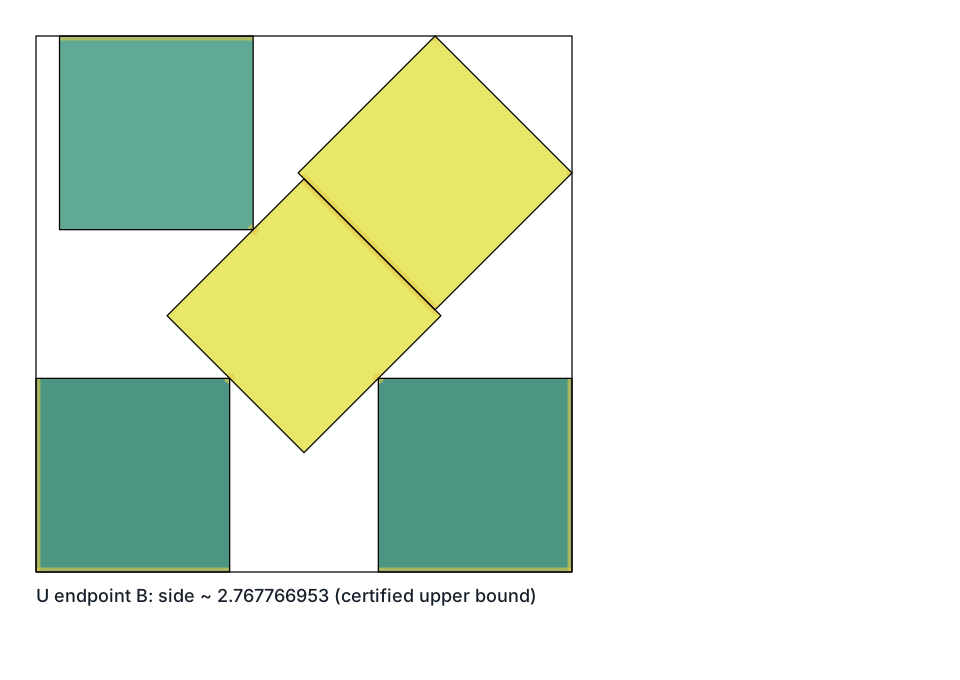
The renderer’s standing exact-motion control remains independently replayable:
As of 2026-08-30.
agenda-008
is closed with all four commitments terminal;
session-045
then ran nine unplanned phases on BC-049 at and carries a handoff at its end
that is the authoritative summary, and
session-046
took the cheapest thing that handoff named.
session-047
then left the mathematics alone and worked on the record itself: it promoted the three
sizes whose exact certificates were already running in this gate while their records
denied one existed, and filled in the two facts the register could not previously state
— whether anyone here has read an external argument, and what a novelty claim was
searched against.
session-048
closed the same gap one level up, joining every session to what it cost and finding that
both obvious ways of totalling that were wrong in the flattering direction — see
Sessions Conducted.
session-049
then did three things in one morning: reconciled the queue against the tree (BC-085
and BC-087 had landed while the agenda still advertised both as ready), built the
pre-push floor BC-086 asked for (packing-validate --push, 58s against --fast’s
646s), and ran the BC-088 reassessment whose sequenced plan is
X-009 — then
executed that plan’s first block: twelve verified ceilings moved off the integer grid
onto exact sides at , every one
decided by exact sign — ten over and the last two over , the
first exact verification outside — from a published rule or a coordinate
lift, about of aggregate gap.
The widest trailing ceiling is now ’s .
session-050
then performed the independent audit exp-045 had waited on since registration, built
the -W bridge that makes the accepted helpers corroborate the certificate, and
recorded the owner’s acceptance — clearing the gate that held BC-010 and BC-029.
Queued for the next run:
agenda-010 — the
two-lane overnight program from
X-010: nine hours in
blocks of two to three hours, instruments before research in both lanes, a checkpoint
(BC-098) resequencing the tentative half mid-run, and the standard unattended rules
stated in the agenda’s own objective.
The run is live: blocks 1 and 2 are complete —
session-054
landed the certifier core and the falsifier (BC-093, BC-094; the session ran as 050
and was renumbered at the merge — the audit session above holds that number), and
session-051
landed the stage-1 price and the exact-LP measurement (BC-095, BC-096) — and the
checkpoint
(session-052) has
resequenced the tentative half;
session-053
closed block 3 on BC-099 under think-1o1f with the run’s first research result:
Bentz 2010, Theorem 8 () machine-certifies as printed — 92 exact cells over
, the Lemma 5 threshold by a rigorous rational subdivision bound
of , all 45 points charged — held unresolved with needs_review under the
unattended rules that night (resolved by the review below), with the remainder
typed on think-1o1f and one candidate printed gap flagged for replay.
The same session absorbed a mid-run merge from main (the parallel audit session had
taken session-050 and D-404, so block 1’s record is session-054 and the
reassessment defects are D-405/D-406) and root-caused the base branch’s red full
surface to two stacked control defects, D-407 and D-408, both fixed on this branch.
Block 4 is complete too
(session-055,
BC-100): the H-044 chunk-expressibility verdict exists as exp-046, exploratory by
the hypothesis’s own calibration-only amendment, held unresolved with needs_review
that night (resolved below) — the criterion is missed under both denominator
readings the registered text supports (23/30 = 0.7667 over all records at ;
3/10 = 0.30 over the non-grid sweep records), identically in both bands, every miss
typed and determinate.
The measured mechanism: the lattice grammar expresses the grid stratum completely and
the tilted stratum not at all (flush groups are tangentially slid off the integer
lattice step), so stage-1 over this grammar is a restricted-class instrument —
converging with BC-095’s repricing from the price side.
Block 5 closed
(session-056):
BC-099’s own question continued under think-1o1f — the m = 4 foundation layer.
Two results landed on first complete runs, both held that night for review (resolved
below): Figure 2’s sixteen-point base configuration is machine-certified (30 exact
rational cells: 4 Lemma 1 corner pentagons, 8 Lemma 4 wall rectangles, 18 Lemma 2
triangles; 16/16 charged), and Lemma 10 is machine-settled both ways — the printed
replacement point is refuted by an exact escape certificate, and all three
corrected replacement sets (, , (1.87, 0.76)) certify exactly,
their Lemma 5 quadrilaterals landing inside the very parameter families the paper’s
Section 1 lists. The certifier gained subset semantics, margin and near cells, and the
rational-a threshold bound along the way.
Block 6
(session-057,
BC-101) then moved the verified lower lane for the first time since 2005:
and , certified exactly by a sixteen-point
unavoidable set in (cases/green17) — above Nagamochi’s ,
below Green’s unadoptable — the cell plan pinned to by an
slack, the falsifier corroborating by saturation, and the verdict held that
night for review; the review’s independent audit then showed was the plan’s
ceiling rather than the set’s, and the upgrade below carries the adopted bound.
The run then discharged the checkpoint’s two authorized fillers and closed early.
Session-058
(BC-103) sized the attempt exactly and parked it: the m = 7 pattern’s ceiling
sits below both side 8 and the standing
at , with the lattice dilemma exact (8 rows overrun the Lemma 2 pitch
cap by ; 9 rows overrun the 60-point budget by 7).
Session-059
(BC-102) built the τ* pilot and read the method diagnostic: the eleven-crossing sits
near side (uncertified, typed), so a pure eleven-point set has at most a
-wide window above and any ambitious bespoke bound
forces the threshold/segment/moving-resource machinery.
Everything mathematical from the run was held unresolved with needs_review overnight
per the unattended rules; the verification review below resolved every hold the same
day.
As of 2026-08-31, evening. The owner moved the review from their queue to the
repository’s own rubric — determinations, not deferrals — and
session-060 is
running it as BC-106 under think-ngf0 in
agenda-011.
The determinations, each grounded in conventions.md §4 and
the frontier evidence contract: Theorem 8’s audit is verified and fully
machine-checked (E-bentz46-theorem8-audit); the Lemma 10 settlement is verified and
now source-settled — the published page image itself prints the transposed
, so the defect is the journal’s, recorded as defect-found on
E-bentz-2010-proof with the partial Theorem 9 audit in E-bentz13-figure2-audit;
exp-046’s hold is cleared with H-044 undisposed by its own registered amendment (the
miss is determinate under both readings); the m = 8 parking statement stands as exact
arithmetic; the τ diagnostic stays uncertified by construction* — final typed
status, nothing pending.
The green17 determination became an upgrade: the independent interval certifier built
for the review (cases/green17/interval_audit.py — exhaustive exact integer
branch-and-bound over the full pose space, pair-handoff and wall-tightened discharge
rules, negative controls refuting tampered sets and oversized sides with exact
witnesses) proved the run’s was the cell plan’s ceiling, not the set’s: the same
sixteen points certify at , the cell certificate was rebuilt
there (right-wall Lemma 4 rectangles replacing the near-slabs), and
verified_lower_bound at and moved to on two independent
formal methods (E-green17-sixteen-point-lower, E-green17-interval-audit), the
set’s exact ceiling bracketed by certification
at and refutation at and typed as follow-on.
The assembled case is the 2026-08-31 verification review under docs/project/reviews/;
the owner reviews the PR as a whole.
Follow-ons stay on their beads (think-1o1f, think-q6vy, think-07t7 paused,
think-0z9b); BC-097 and BC-089’s remainder remain the sanctioned gate filler.
Session 061 summary. The review’s epistemics became infrastructure: verification is
the highest rung supported by the evidence a result cites, regardless of who performed
it; confirmation records what this repository has read, replayed, or established.
Session 061
codified that distinction as BC-107 under think-n8vl in
agenda-011, a
pipeline-improvement slice.
epistemics.md at the repository root now owns the four axes —
V0–V5, C0–C5 with structural promotion checks, anchored significance that never
gates, and a scoped novelty classification — and the results register
(packing/frontier/results.yaml, rendered as
RESULTS.md) declares the whole results T-001–T-016,
whose declared rungs devtools/check_results.py checks against cited evidence, required
notes, and review metadata on every validation run.
Unsupported promotion and unexplained understatement fail the build.
The register subsumes the review’s determinations (the /s(18) upgrade is
T-001/T-002 at V4/C4) and the legacy first-party theorems (the Stromquist repair
is T-010; this document’s own T-1–T-4 below remain declared shorthand).
softschema is upgraded to 0.8.0 across the schema toolchain in the same slice.
The one-shot post-merge check found main’s full surface still red on one negative
control, behind the same mask D-407 named: the worker-snapshot link copy covered the
pruned archive but not the pruned renderings, and the control’s expected message lagged
the ledger’s round count — fixed as D-409 and D-410 on this branch, with
epistemics.md added to the snapshot’s root documents before the same gap could ship
again. Research follow-ons are unchanged on their beads.
As of 2026-08-31, late evening — historical agenda-012/013 launch record.
X-011 reconciles the
new weighted certificates, the precision gap, the medium-case
construction ladder, and the opportunity cost of a thirteenth open-ended round.
Agenda-012
turns that synthesis into three disjoint first-wave blocks with real beads and 15--30
minute check-in cells: BC-108 runs an independent-implementation agreement check on
the proposed certificate while naming shared assumptions; BC-109 builds the
hash-verified parent-child serialization bridge at ; and BC-110 decides
whether can become the rational exact-promotion control.
They were scheduled to run in parallel, followed by BC-111’s bounded checkpoint.
The dependency-linked successors are already filed.
Agenda-013 is the
owner-authorized nine-hour execution graph on one pull request: 150 minutes for those
three first-wave blocks, a 15-minute W5 efficiency checkpoint, 30 minutes for BC-111,
180 minutes for one positive or refusal-path continuation per lane, 30 minutes to
measure throughput again and freeze review packets, 90 minutes for three independent
reviewers, and 45 minutes for synthesis and final validation.
Every wave boundary requires a commit, tbd and generated-view reconciliation, validation
receipt, push, and PR update.
Existing BC-010 gets one final 90-minute discriminator with a matched
transfer under dedicated bead think-iivb. Its first cell freezes both fixtures, the
observable, threshold, and refusal conditions before measurement.
Only a passing transfer may remove BC-011’s blocked hold; a refusal stops the
dedicated BC-011 through BC-014 chain and parks H-023. Legacy owner think-1s0h is
not the queue gate. Those launch instructions are retained as chronology; use the
Current Handoff for the live entry point.
The parallel recognition slice remains BC-089 on think-d0j1 in
agenda-009:
agenda-012 transfers to BC-110, leaving thirteen disjoint cases on BC-089;
follows only if that result shows nested-radical representation is the next
missing seam. The robust-rational sweep and typed refusal remain on the parent
bead. BC-049 on think-xdly is the research cell all of the mathematics below sits
under, and it stays open.
is infinitesimally flexible, exactly, over : seven retained
directions turn the sixteen squares of its tilted block and leave the frame fixed, and
every one is refused at second order by a verified self-stress.
The property stays undetermined because an infinitesimal flex is not a motion — the
gaps curve shut at order — so what is settled is that no first-order argument
can establish rigidity there.
Getting further needs an instrument this repository does not have: the cone is bounded
to dimension 45 against six dimensions of anything found admissible, and closing that
gap means reasoning about corner disjunctions without enumerating them.
The correction underneath it generalized.
Göbel’s published family is exactly the best known at , , and ;
all four now have exact constructions here, and the last two turn out to be what their
retained decimal witnesses were all along — agreement to identifies
rather than merely permits.
is the near miss that stops the obvious guess: the family gives it a valid
packing worse than the best known, whose optimum is at algebraic degree 6 and is
not in the family at all.
Take the next slice from agenda-map.md.
BC-017 delivered its readiness input and stopped there.
The full-cell control already retained the target-free execution-plan receipt
the commitment asked for, so the slice produced what that receipt authorizes instead: on
the same three-square subject the structural plan reports 4 seated-wall equalities and 8
open-wall inequalities against 2 contact equalities and 1 non-edge inequality, while
solve_cell builds 12 containment rows and 3 pair rows — the same twelve and the same
three. Every total agrees and every composition does not, so the LP-solve half of the
exit is reachable and pair_tests does not transfer between instruments that both
report it.
BC-019 is closed. The contact-assembly contract is at contact-assembly-v2-draft and
carries the clause it never had — 17 certificates and 13 typed limitations over
— with the missing grammar move named rather than guessed: a primitive for
axis-aligned polyominoes that are not a bar, rectangle or corner L. BC-024 is what
made that safe to say:
X-008 measures
that every component the grammar cannot express is axis-aligned — every
other-polyomino in the corpus has angle exactly zero — so all 295 tilted components
are already covered.
Wall seating splits the residue into two populations with nothing between them: 44
whole-record grid subsets on four walls, 65 corner-seated blocks on two.
BC-038 is closed and rejected on measured arithmetic — 35 evaluate_stress calls
arrive with eleven distinct number fields, and RowJetInventory refuses a foreign
field by identity, so the floor is a 1.54x ceiling against an exit wanting five-fold.
BC-010 and BC-029 were gated for four days on independent acceptance of exp-045’s
preregistered criterion, which an unattended runner may not grant to itself; on
2026-08-31 the owner accepted the round after session-050’s independent audit (findings
and the corroborating -W bridge are the experiment record’s Amendment and D-404), so
exp-045 now records decision: accepted, BC-029 is complete, and BC-010’s
readiness on the map is genuine.
is second-order rigid, and that is a first-party result.
X-007
settles the question BC-049 asked, exactly, over at Göbel’s construction
rather than at the retained decimal witness — which is off the
diagonal and so infeasible at the scale a certificate works at.
The cone of infinitesimal motions is exactly the line spanned by rotation of the middle
square; the other fourteen coordinates are pinned by Farkas certificates verified in the
field; and that one direction is refused at second order by a verified self-stress.
This confirms and strengthens the numerical account BC-069 reached from the promotion
side, including its observation that the contacting corner sits at the midpoint of the
contacted edge — which turns out to be the reason for both the first-order blindness and
the second-order obstruction.
The frontier property stayed undetermined then, and the reason is worth carrying
forward: second-order rigidity is not local rigidity, the step that would close the gap
is a curve-selection argument that X-007 writes out as prose and no replay checks, and
the property enum has no word for what was actually established.
What did change is everything saying why — verified rather than numerically-checked,
exact-algebraic rather than numerical-multiprecision, and a first-party evidence id
in place of the screen’s — which takes out of the assessment tool’s ownership,
so it joins as left to a stronger argument.
Both D-354 guards stayed green without being edited, which was the test the change was
held to.
For that stronger argument arrived on 2026-09-03. BC-152 wrote the
curve-selection step out in full and checked it against an exact accounting of all 400
local inequalities, BC-153 reviewed it independently, and the property now reads
locally-rigid at fixed side on a second first-party evidence record — see
T-014.
Read OR-4 before trusting any older queue. BC-081 found
that agenda-005 was advertising four commitments as takeable which agenda-006 had
already discharged, and four more blocked on conditions no reader could observe.
That is D-374, and the repair is agenda-map.md,
generated from every agenda and drift-checked in --records at 0.14s. It is the queue
now; BC-010 maps to its dedicated think-iivb gate, while think-1s0h remains the
broader H-023 research owner.
The identity question moved twice, and both moves were corrections.
X-005 still
declares contact + closure the relation the atlas should count, but D-375 records
that it had scored the atlas’s own relation at the wrong level — both of that relation’s
inputs are canonical under relabelling and D4 by construction, so it is a quotient
statement, and the labelled control it was refuted on can refute no
relabelling-invariant relation at all.
X-006 then
answers the question this handoff previously posed.
does admit a discriminating control, and it is the pair D-034 has been
quoting since 2026-08-23 without ever retaining: two endpoints sharing a contact
certificate, differing in geometric key, at a side difference of .
It is retained now, and it discriminates whichever way its component count resolves —
the branch where the count is two refutes contact + closure itself.
What it waits on is that count, and exp-042 already names the missing claim:
A_to_B_stationary_connection, first of its eleven declared scope refusals.
D-034 stays outstanding, and no proof obligation shrank.
Everything below this paragraph is the accumulated record of how the program got here,
not the next action; agenda-005 is closed and appears in it as history.
Block A is closed: BC-047 under think-y85e and BC-042 under think-zmh8 both
met their declared exits in
session 035, which
is terminal. Precision is now manufactured in-repository rather than read off a source —
the published system refines to 1000 declared digits with a reported residual
bound of — and the contact structure is frozen with
89 incidences, six orientation classes, an empty ambiguity report and decades
of separation, with the same extractor reproducing the known structure exactly
under exact arithmetic.
BC-045 is now closed at all four phases, in
session 036
and
session 037,
under agenda-006.
The interval route is built, calibrated against , and , and run
at , where it certifies at a
declared relaxation of . That certificate is retained unresolved with
needs_review: true and promotes nothing: it sits below the
standing verified ceiling, and whether it moves verified_upper_bound is a reviewed
human decision through the evidence contract.
BC-054 is closed in
session 038:
contacts now identify which features meet, and assembly turns a structure into equations
that vanish at the packing they came from.
Three findings there went against the promotion spec — counting rows cannot say whether
a system determines the pose, an angle class does not license an angle identity, and
seven of the squares are reflected and refused by name.
The rank half of the first was later found to be measuring a bug rather than the
packings: see the BC-059 paragraph below and D-361.
BC-056 closed that first stretch, and the run then resumed rather than ending: a
review of the commit timestamps showed it had misread its own clock and stopped with
most of its budget unspent (D-358). BC-057 is closed in
session 039,
which built the interval checker and recorded the certificate as evidence
without promoting it.
BC-058 is closed in
session 040: a pose
is now a centre, an angle and a chirality, so the reflected squares are assembled
rather than refused and the residual falls from to
with the calibration unmoved.
The feature-renaming cost that commitment was written to weigh was not paid — reflecting
the local axis leaves the corner indices alone.
BC-059 is closed in
session 041, and
the answer was that there were no stationarity conditions to derive.
The shortfall close had been reporting — four at , seven at — was a
bug in assembly rather than a property of the packings: an edge-edge contact was
written as one equation where collinearity in the plane is two, which left one square
free to pivot about the shared point and drive its neighbour open at first order.
With both endpoints of the edge on the line the contact Jacobian reaches full rank at
both sizes — of at and of at — residuals unmoved
at and , and close now refuses at both.
It is D-361, class soundness, direction conservative: it made the
pipeline look further from a solvable system than it was.
Göbel’s has no edge-edge contact, is untouched by the repair, and kept a
genuine shortfall of one.
BC-069 closes it, and the answer corrects the form the pipeline had been promising.
The condition is not first-order: side_leak reads there, so “no
admissible motion decreases the side” is already true and adds a dependent row.
The single free direction is a rotation of the centre square about its own centre, and
the contacts fail along it at in both signs — an ordinary second-order
obstruction, so the pose is infinitesimally flexible and second-order rigid, and the
shortfall is a degenerate root rather than an unpinned optimum.
Differentiating the contact map along that direction takes the rank to 16 of 16 with
the residual unmoved at , and each emitted condition expands to
exactly the statement that the contacting corner sits at the midpoint of the contacted
edge — an identity of the corner-edge contact type, checked against a midpoint
expression written independently of the derivative.
Both determined sizes are unmoved.
The misnaming is D-363.
BC-060 is closed in
session 042, with
one answer and one refusal.
At the promotion spec’s frozen margin rule recovers Trump’s published
degree-eight minimal polynomial from digits alone — , , ,
a relative residual of at still falling to
at — and discharges it as irreducible over with an
isolating interval containing the refined value.
At , on a thousand digits with a reported residual bound of
, pslq returns nothing at any degree from 2 through 20
below a coefficient bound of : not one degree reached a clause.
The contrast is the finding, because the planning probe on the ~98 serialized digits got
relations at almost every degree from 8 to 21. A search that answers when under-fed and
falls silent when fed properly is evidence about the number, and what it bounds is
concrete: if the Kingbird solution has degree twenty or less, some coefficient of its
minimal polynomial is at least . That is the measured reason the interval route
carries the bound.
BC-065 is closed in
session 043, and
it says how to read that refusal.
Under the published system rationalises over into six
polynomials with total degrees , so the Bézout bound on the
solution variety is : degree twenty surveyed a corner of the space, not
the space. Every equation is degree one in , and solving the smallest for it gives
as a rational function of two half-angles alone, leaving five equations in five
unknowns. Eliminating those is where the exact-algebraic route either succeeds or is
shown to be out of reach at , and it is left to its own budget on think-obgk.
The bound reads as “not small” rather than “this large” — Bézout is loose for a
structured system.
The next slice is BC-066 under think-obgk — eliminate the five
equations in five half-angles that BC-065 left, inside a declared cap, because it is
the only remaining block that can change what this run concludes about .
BC-061, BC-069, BC-067, BC-068, BC-062 and BC-063 follow, with BC-064
reserved and last; the ordering and its reasons are the
continuation schedule,
and
run-002
carries what a fresh agent needs that the diff does not show.
Session 044 is
terminal, and closed eleven commitments.
The next slice is BC-074 under think-eb29, and it is a documentation-pass.
That workflow — W8 — is new, added because this run demonstrated the gap it fills: the
record moved a long way in a day while the front door did not move at all, and nothing
in the gate noticed.
check_synopsis binds this document to the artifacts; there is no equivalent for
README.md or TUTORIAL.md, so they drift silently.
Its checklist is the
documentation-pass runbook, and its one hard
rule is that it reconciles rather than authors: a claim the record does not already
carry is not a documentation change, and a disagreement the artifacts cannot settle is a
defect rather than a rewrite.
D-367 is what the alternative looks like.
BC-066 attempted the elimination and reached a measured wall rather than an
eliminant, which is the exit that commitment names.
Three msolve runs on the six-equation system: over in an elimination order, F4 was
OOM-killed at degree 32 after 25m09s with 13.8 GB resident, having completed degree 31
on a matrix; mod in the same order the matrix
dimensions were identical degree for degree; and mod the same prime in plain grevlex —
an order of magnitude cheaper per matrix — the pair list still grew monotonically to
21,661 with no basis inside a declared 25-minute cap.
Neither predicted failure mode is what stopped it. Coefficients cannot swell over
, and the cheapest monomial order did not terminate either, so what the runs
measure is the size of the ideal rather than the arithmetic carried through it.
The claim is narrower than “out of reach”: two threads and 15 GB is not a proof of
intractability.
What it establishes is that the interval route carries the bound
for a measured reason, and that the next thing to try is a smaller question rather than
a bigger computer.
That is BC-070, and its first half has landed.
Homotopy continuation needs no basis at all, and the mixed volume of the Newton
polytopes bounds the isolated solutions at — sixty-six times tighter than
the Bézout bound of , computed in nine seconds.
The stable mixed volume is equal to it, so the bound covers every isolated solution
rather than only those in the torus.
So the Kingbird solution has algebraic degree at most . Kingbird’s, not
's: is the optimum, Kingbird’s packing is the best known and is not
proved optimal, and the bound gap there is about . That is still far beyond what
an integer-relation search can reach, and saying otherwise would overstate it: what it
replaces is an unusable bound with a merely large one, computed from the system rather
than guessed.
BC-067 closed the exact route’s loop at , where the answer is published.
discharge stops at the side, which is a claim about a number; the round trip carries
it back to a claim about a packing — eleven squares, fourteen touching pairs, valid
under exact_sign, and the reconstructed side equal to the field generator exactly.
The obstacle is real and is where it is avoidable: a pose unknown is an
angle and has no representation in at all, but Trump’s construction is already
over with , so the question reduces to recovering from .
That recovery is a derivation rather than a search — , both degree eight,
so writing each in the power basis of gives a square rational system with
one solution, and a singular one is refused rather than fitted.
The continuation runs the missing middle layers first, with the efficiency and research
cells deliberately last.
The full ordering for the sessions after it — including which of the two priority: 0
commitments goes first and why — is the
session queue,
which is the one place that ordering is written down.
The narrative below is historical and its earlier “next bounded slice” pointers are
superseded by this paragraph.
The replan followed a correction recorded in
X-004.
The retained SVG does not merely serialize a FindRoot result: it publishes
the complete closed system — nine slide scalars in closed form and six equations
in — and the layout map, whose
<use> transforms are written symbolically in those same names.
cases.kingbird29.verify_svg had already
transcribed all of it and used it only to evaluate residuals, never to solve.
Solving that same transcription reproduces the record to all fifteen published digits
and reaches a maximum equation residual of in about six
seconds. So BC-042 and BC-043 gate nothing at ; they generalize the route to
sizes with no published system.
That moved the prize onto BC-045. Certifying the reported value would move
verified_upper_bound from the Schadt rational to Kingbird’s, closing
. Two routes reach it: BC-044 recovers a minimal polynomial and
discharges it exactly, which is stronger but of uncertain feasibility — a completed
sweep found no integer relation through degree twenty with coefficients below
— while BC-045 needs no polynomial at all.
The robust route was the one with no specification, so that specification now exists.
The witness contract already named interval-certified as a method that may carry
verified, and the checker is now built: scalar.kind gains interval-enclosure,
exact_verify replays an interval witness instead of raising checker-not-built, and
the certificate is retained as
kingbird-n029-2026-interval
under E-n029-interval-certified-upper.
Recording is not promotion: verified_upper_bound has not moved to it.
The standing rule is unchanged and applies to every block: an unattended runner may
apply the accept rule only conservatively.
A round that certifies is recorded unresolved with needs_review: true, and
a human makes the accept decision.
PR 45 is merged and
session 025
is terminal.
Session 026
is the terminal first-session midpoint in the two-session
balanced ten-hour agenda.
Session 027
stopped on an external provider usage limit after ten of eleven phases, and
session 028
is the terminal successor that executed its one unexecuted phase.
Session 029
closed the remaining agenda-003 commitments on measurement, and
session 030
re-glossed BC as bounded commitment, retiring a collision with the
linear-programming sense of cell, and made the bead / commitment / phase layering
explicit in the orientation docs.
Session 031
merged main and found the merged tree failing two gate steps the pre-merge tree passed,
because the atlas SVG work pushed the negative-control mutation snapshot past its size
cap. That is fixed and pinned, and the gate is green on the merged revision.
Session 032
closed agenda-004’s first block: twelve pre-certificate mutations are now enforced on
twelve distinct failure identifiers, so exp-045’s admission gap is closed.
Session 033 ran
exp-045 itself, and
session 034 is
the terminal successor: it closed BC-035 and BC-041, adding four guards that did not
exist, each verified to fire rather than merely to pass and each pinned by its own
negative control. Negative controls rise from 76 to 80. The next bounded slice is
BC-038 under think-kdil, the row-jet inventory reuse, which exp-045’s terminal
disposition unfroze.
Both declared determinations report criterion_met — canonical pure -W is excluded at
A, the interior, and B, and the -W coefficients equal the separately derived +W
values — and record-and-replay agree.
The round is recorded unresolved with needs_review, not accepted: an unattended
runner may apply the accept rule only conservatively, and the sixth admission condition,
an independent post-change audit, is outstanding.
The next bounded slice is BC-035 under think-cja6, the pipeline guard consolidation,
because exp-045’s acceptance waits on a human and the mixed and transverse successor
directions have no instrument.
Exactly four distinct reachable failure modes existed, with no slack: a first inventory
counted seven candidates by grepping raise sites, and tracing proof_core’s call graph
cut that to three reachable identifiers across four conditions.
The n=29 certificate was also regenerated at the tool’s default precision, closing a gap
between the documented command and the recorded artifact.
Q-BC032-a is answered: the relaxation is an artifact of the
promotion route, not a property of the pose, and six independently verified promotions
beat the recorded baseline.
BC-028’s trigger passed, so its inventory-reuse implementation is ready but sequenced
behind exp-045. The outstanding work is now carried by
agenda-004,
which gives each remaining item its own workflow entry.
BC-027 is complete.
The H-023 successor under BC-029, think-whwc, and think-1s0h is no longer
an instrument blocker: exp-045 has run and is terminal — accepted since 2026-08-31,
after the independent audit its registration required — excluding canonical pure -W at
all three strata while every connectivity, component, isolation and terminality claim
stays refused. CG-010 is structurally complete under BC-030; BC-016 is blocked under
think-3yv8 on retained poses, an executable glued row, symbolic tie labels, and a
receipt checker, while BC-017 under think-u97a remains the ready constructive W7 lane.
All frontier entries now point to normalized witnesses and
deterministic house renderings.
The first hundred are calibration evidence, not an unseen holdout and not a new proof of
optimality; , promoted on 2026-09-07 under the
expansion plan
and frozen at commit 6e21c4ca, is the unseen corpus a confirmatory run may use once
its instrument and grammar are frozen, and the calibration-only layers stay pinned to
the first hundred. The atlas source inventory retains attributed Kingbird-derived
numerical facts but no raw Kingbird SVG because the review located no express
redistribution terms; that conservative repository policy is not a legal conclusion.
A broad same-angle contact census covers 1,782 of 1,860 non-grid squares, but the
stricter bar/L/rectangle partition establishes 3 of 36 non-grid cases inside its narrow
budget. Two cases are conclusively outside that budget, 23 have no partition in the
registered candidate universe, and eight are search-capped and therefore indeterminate.
Contact components also retain substantial internal sliding freedom, so component count
alone is not a defensible chunk cost.
The target-free contact-scaffold layer now retains 11,013 exact size-five signed-contact orbits as an abstract, no-geometry atlas. Its local realization prefilter rejects mixed angle classes before solving and still omits walls, non-edge separation, container fit, whole-packing feasibility, and optimality. CG-010 now adds one separate literal axis-aligned three-square structural cell: all twelve wall decisions, every contact/non-edge pair and oriented axis, the 48 D4-by-relabeling images, a replayable canonical witness, and separate candidate-domain and executed-work prices. It performs zero LP solves and contains no geometry. BC-016 prerequisite instrumentation remains blocked, so the next boundary is BC-017’s target-free tagged structural execution plan and derived accounting. Actual numerical compilation remains blocked on unfrozen open-wall, nonedge, and contact-overlap semantics. This is not an H-044 verdict or an run on the inspected calibration corpus.
The H-023 line shows why the distinction matters.
Session 004 used W3 to turn an ambiguous terminal-family observation into the
falsifiable connectivity hypothesis.
Session 009 first used W4 to make basin events and exact identity controls admissible.
W6 then produced exp-033’s exact fixed-angle face and exp-034’s angle-and-slide sheet.
A W2 instrument review found D-194 and D-195 before the next measurement, preventing a
reused contact differential and an invalid alternative-row interpretation from entering
the result.
W6 resumed only after the corrected criterion was frozen; exp-035 then proved
exact first-order directions outside the sheet without proving nonlinear realization.
W3 turned that limitation into exp-036’s registered second-order obstruction, and W6
then excluded the displayed direction from the true tangent cone.
Exp-038 now certifies the complete branchwise linearization-cone inventory and leaves
transverse and mixed nonlinear realization open.
Exp-039 then certifies one connected five-dimensional fixed-angle cell-local LP-optimal
position polytope and twelve exact paths in release classes R1, R2, R3, and R6. Its
positive pathwise first-order stresses do not make the whole polytope stationary or
classify a terminal component.
When the post-round strict gate failed, W4 separated stale controls from an independent
deep-golden solver rejection.
That bounded solver repair was recorded under the owning review phase before W7 existed.
Future packing-pipeline repairs whose promised output is the implementation itself enter
W7; historical phases are not relabelled after the fact.
The current terminal transfer line is owned by BC-010 under think-iivb; think-1s0h
retains the broader unresolved H-023 question without gating the agenda.
Session 015 is
terminal after reaching its declared eight-phase cap, and
session 016 is
the completed final-hour continuation; it preserved the original deadline without
extending an expired phase or relying on controller memory.
Session 017
is the initial W5 efficiency record, and
session 018
is its measured planning refinement.
Session 019
corrects the Codex timing instrument, freezes both named task trees, and replaces
estimated delay attribution with native per-turn rollups by model and thinking level.
Session 020 acts on
that baseline: the first hosted required surface finishes in 46 seconds, exhaustive
exact work and complete macOS move to direct integration events, and two-worker controls
save 58.22 seconds on the full branch.
Session 021
updates that lane onto current main, restores cheap exact guards to required PR
validation, preserves explicit worker caps, and targets PR 45’s measured census tail.
These W5 sessions measure and improve the research and validation loops but do not
supersede session 016’s scientific handoff or authorize exp-045 implementation.
Session 015’s first bounded W6 slice stopped exp-040 unresolved before retained
measurement after independent review found five finite proof-perimeter gaps in the draft
R4/R5 checker. Exp-041 froze the exact five-blocker correction at e26fae9, then
rejected its complete-zero-inventory criterion on a new endpoint-only axis without
refuting path feasibility.
Exp-042 corrects that endpoint inventory and meets the full frozen criterion from engine
commit 2980fdc: six R4/R5 paths, both owner stresses, and twenty semantic controls
pass retained generation and replay.
The result is pathwise first-order only.
Exp-043 then stops its pure -W test before retained measurement: the draft checker is
a resume point, but it does not yet derive production rowwise second-order constants,
consume a full exp-034 acceleration witness, or mechanically route the two-scale proof.
The following W7 phases provide a case-free exact-jet helper, complete production row
builders for all six source matrices, normalized nine-row stress evaluation with every
correction column retained, and a formula-derived exp-034 sheet control across both
owner inventories. Focused tests and independent review accept that substrate at
checkpoint 8ee367b while refusing branch completeness, scale routing, and obstruction.
Exp-044 freezes the separate case-level integration but is terminal unresolved with no
target run or result JSON. The published checkpoints separate helper substrate
8ee367b, accepted memoryless design 027349b, and full-gate pre-terminal state
3629bf4. Session 016’s terminal handoff owns the branch, read order, validation, exact
fifteen-record scale inventory, mutation map, and successor artifact paths, so no
controller memory is required.
Session 027’s active BC-017 slice under think-u97a builds the admitted target-free
tagged structural plan and exact derived accounting.
It retains full-cell-execution-semantics-unfrozen instead of compiling or running a
numerical full-cell solver before returning to the scheduled W5 inventory.
Exp-045 remains a typed instrument blocker with no pure -W target data.
The -W, mixed-angle, whole-stationary-component, and unequal-side-clearance questions
remain later slices; D-239 is a separate W7 line.
Do not start basin-frequency work or reinterpret exp-035 through exp-040 as a
connectivity proof.