s(11) ≥ 381/100
A New Lower Bound on the Square Packing Problem
A New Bound for Packing 11 Squares
This work presents a new lower bound on a long-standing open geometry problem: eleven unit squares with disjoint interiors, free to rotate, cannot fit in a square of size .
This appears to be the first improvement in 23 years on the smallest open case of the square packing problem.1 Stromquist published the previous bound of 3.7888543… in 2003.23 The tightest known packing, due to Trump in 1979 (Figure 1), shows .4
The computer-assisted proof of the new lower bound was found via an automated research framework. The certificate used in the proof places 1,121 rationally weighted points in the container and selects a net of 181 rationally parameterized directions. Five exact conditions and a pigeonhole-style argument then imply the claim. Verification is exact rational arithmetic: the one-file checker, about 330 lines of standard-library Python and short enough to read in one sitting, decides the certificate file of 1,121 weighted points in about a minute.
The Agentic Research Framework
All of this project’s documents and code, including this paper, are written by agents. The repository uses a flexible but defined agentic research framework, which is fully documented in the repository.
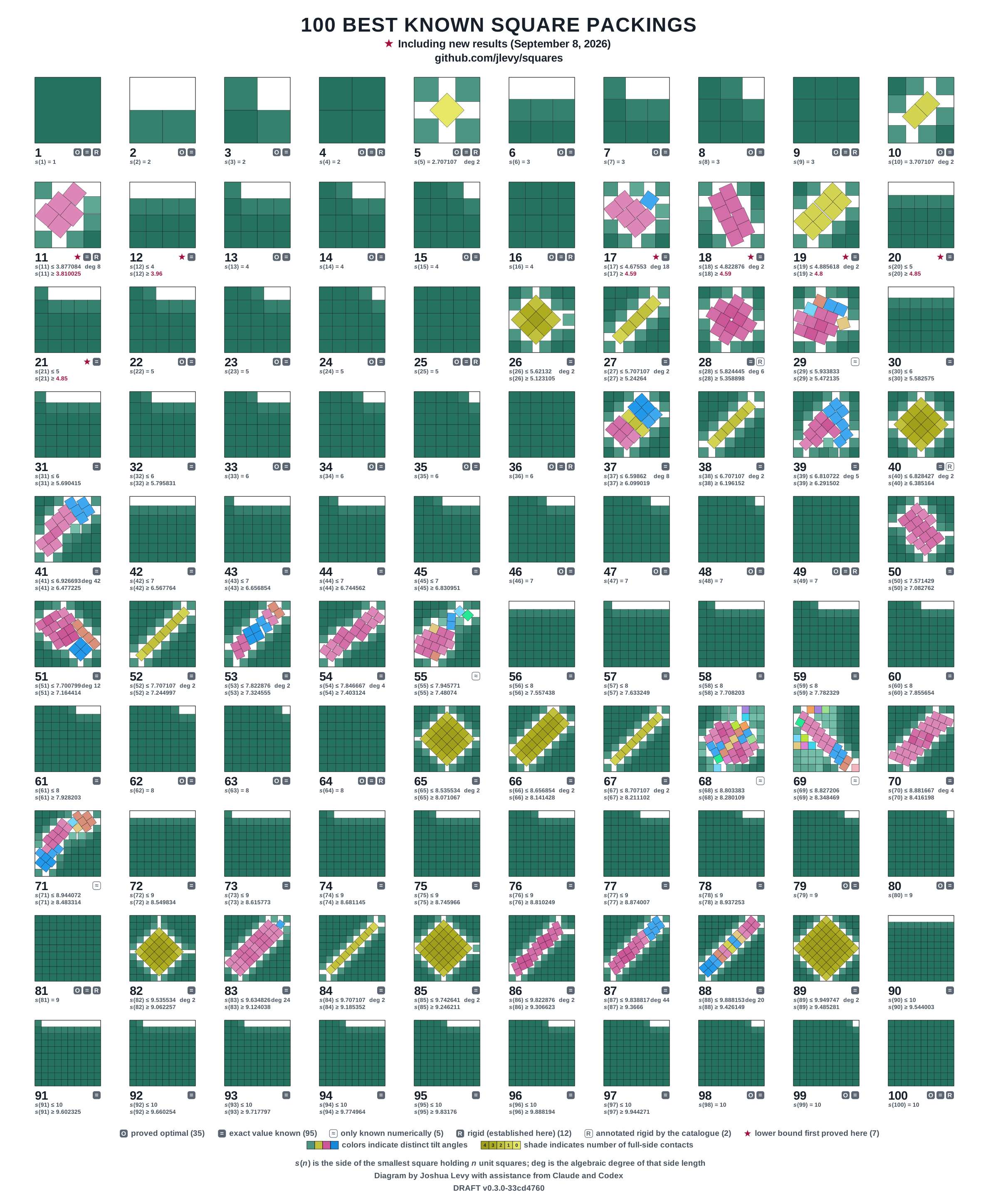
This lower bound is one of 22 results the framework has registered so far, 15 of them apparently new. These include improved lower bounds for , , and .5 The atlas of best known packings for every from 1 to 100 in Figure 2 comes from the same research agenda and currently includes 7 new lower bounds.
The repository includes:
- A comprehensive survey of previous research
- The atlas of packings
- A hypothesis registry
- An experiment ledger
- Exact verifiers and other tools
- A retention gate that labels results according to epistemic status (levels of verification, confirmation, significance, and novelty)
Work is planned on a regular cadence, typically in blocks of 8 to 12 hours, with strategic human input on priorities and insights. Agents then break the work into defined workflows, including research survey, correctness verification, research loop, and optimization loop.
The framework relies on several agent tools for better engineering and workflows, notably tbd for task tracking, Softschema for structuring results, and Practical Prose to improve writing quality.
Even with the best agents, research requires strategic human input. The framework lets that input focus on strategy, while agents build on accumulated results and tools in a research flywheel. This approach is likely to be useful for other creative mathematical or technical problems.
The Square Packing Problem
The square packing problem asks, for each , for the side of the smallest square that holds unit squares, which are free to rotate and must have disjoint interiors.6 The value of is known for . Stromquist proved .7 The case is the smallest still open.
For values of where is still unknown, results generally take the form of upper or lower bounds. An upper bound is constructive: an arrangement of unit squares in a square of side shows that . Trump’s packing for in Figure 1 is one example. Such constructions may be specified with approximate numerical coordinates or derived exactly by solving the geometric relationships between touching squares. Approximate coordinates alone do not constitute a formal proof of the upper bound.
A lower bound proves that by ruling out every arrangement in a container of side less than . This requires an argument covering all possible placements and rotations of the squares. Such arguments range from simple area comparisons to detailed geometric proofs and computer-assisted certificates. The proof presented here is of this kind.
For eleven squares, we prove .
(Some figures also show the simpler certificate for the weaker bound , whose smaller numbers make the argument easier to illustrate. There is a small exact refinement in T-022.)
The Five Conditions
We prove with a new weighted-point certificate found by our automated search. The five conditions below follow the finite certificate method used by Burns and Massaccesi.8910
The proof uses a finite certificate: for unit squares in a container of side , a finite set of points in the container, each with a nonnegative rational weight (the atoms; every weight in this certificate is positive), a net of directions with rational half-tangents , and a shrink , such that:
Condition 1. The atom positions and weights are invariant under the container’s symmetry group , its four rotations and four reflections.
Condition 2. The total mass of the atoms, the sum of all their weights, is strictly below .
Condition 3. The net reaches : its last half-tangent is at least .
Condition 4. , where is the largest of the net’s half-gap tangents, each the tangent of half the angle between two consecutive net directions.
Condition 5. At every net direction, every placement of a closed square of side inside the container covers mass at least .
Conditions 1 to 4 are exact rational comparisons.
Condition 5 is one exact sweep per direction.
Together the five prove . The certificate is C-n011-fractional-381-100 (a
weaker but simpler one is at C-n011-fractional-19-5). Every figure
below is computed from the certificate it shows.
Atoms, Mass, and the Budget
An atom is a point in the container with a nonnegative rational weight, and here every weight is positive. The mass of a region is the sum of the weights of the atoms in it, a finite exact sum.
Suppose eleven unit squares fit in the side-3.81 container, and suppose the atoms have been chosen so that both of these hold:
- Every unit square that can be placed in the container holds mass at least in its interior.
- The total mass of all 1,121 atoms is below .
The second is a single sum:
Two packed squares may share an edge, and an atom on it lies in both. Their interiors are disjoint, so no atom lies in two of them, and together the eleven interiors hold mass at least . The container holds only . So eleven unit squares do not fit.
Both conditions are properties of the atoms, not of any packing. The rest of the proof makes the first one finite to check.
The Atom Set
There are 1,121 atoms in 149 orbits of , the eight rotations and reflections of the container, with 100 distinct weights between and . An orbit is an atom with its images under all eight, so the set is invariant under the group: Condition 1. That invariance is what lets the proof check angles only up to , since a square at any other angle reflects onto that arc and covers the same mass.
Every Placement Covers Mass at Least One
The covering requirement on the atoms, that every placement of a unit square holds mass at least in its interior, has three continuous parameters, two of position and one of angle.
The proof makes it finite twice over. The angle is snapped to a net of 181 rational directions, and the square checked at each is a slightly smaller one, of side . The next section shows why it stands in for a unit square at any angle. Within a direction, the set of atoms under the square changes only when an atom crosses an edge, so the positions collapse to finitely many event cells, on each of which the covered mass is constant. Condition 5 says every event cell the square’s center can reach without leaving the container, at every net direction, carries mass at least .
Figure 5 evaluates it. Every weight is a whole multiple of , so the readout counts units and rounds nothing. The least covered mass over every placement and all 181 directions is attained at direction , by the square centered at :
a margin of 50 of those units above the threshold.
The net minimum is the least covered mass over all 181 net directions; the button returns to its placement at direction 0. The sampled minimum searches a grid of centers at the current angle; it can miss smaller event cells.
Drag the orange square, or tap to place its center. Tap its round handle to turn by 5°, or drag it to rotate freely; the slider then shows the nearest net direction after square symmetry. Move the slider to return to the net. The shading samples the mass covered at each center position. The dashed outline bounds the allowed centers: outside it, the square extends beyond the container. At a net direction, every allowed placement covers mass at least 1. The preview uses floating-point geometry; the exact verifier decides which atoms lie on an edge.
The net minimum is the least covered mass over all 181 net directions; the button returns to its placement at direction 0. The sampled minimum searches a grid of centers at the current angle; it can miss smaller event cells.
Drag the orange square, or tap to place its center. Tap its round handle to turn by 5°, or drag it to rotate freely; the slider then shows the nearest net direction after square symmetry. Move the slider to return to the net. The shading samples the mass covered at each center position. The dashed outline bounds the allowed centers: outside it, the square extends beyond the container. At a net direction, every allowed placement covers mass at least 1. The preview uses floating-point geometry; the exact verifier decides which atoms lie on an edge.
From a Continuum of Angles to 181
Take a unit square at any angle. A quarter turn leaves a square unchanged, so its angle may be taken below , and the net covers only the arc . A square whose angle lies past is therefore first reflected across the container’s diagonal: the image is a unit square in the container whose angle is on the arc, and by Condition 1 it covers the same mass. Let be the net angle nearest . A smaller square of side at angle , with the same center, covers no more mass than the unit square if it fits inside it, because the weights are nonnegative. So if every placement of the smaller square at a net angle covers mass at least 1, every unit square at any angle does too.
It fits exactly when
where is the angle between the two, at most half the gap between two consecutive net angles. Since on , it is enough that
That is Condition 4, and it couples the two parameters: a coarser net widens the gaps, forces smaller, and makes Condition 5 harder to meet.
The contradiction needs a little more than a fit. Two packed squares may share an edge, so the smaller square has to lie in its unit square’s interior, where no other square reaches. It does: its width across the unit square, , is when , and because with ; when it is , since then . So the interior of every unit square at any angle holds mass at least , as the budget assumed. Nothing there needed the inequality in Condition 4 to be strict, so the strict form the verifier tests is a sufficient condition rather than a necessary one, and both certificates meet it.
Each angle is carried as a rational half-tangent, , so that
are exact rationals and no angle is a floating-point number. The net must reach , the end of the arc that Condition 1 reflects every angle onto. That is Condition 3, and since is irrational it too is tested in rational form:
- \varphi
- nearest \theta
- mismatch d
- largest D
- B admitted
- B(\cos d + \sin d)
Opens at K = 3, the coarsest net the figure offers, where Condition 4 admits only B \lt 0.8787 and the shrink is unmistakable. Tap the round handle to turn the unit square by 5°, or drag it to rotate freely. At K = 180, the net the proof uses, the two squares are indistinguishable.
- \varphi
- nearest \theta
- mismatch d
- largest D
- B admitted
- B(\cos d + \sin d)
Opens at K = 3, the coarsest net the figure offers, where Condition 4 admits only B \lt 0.8787 and the shrink is unmistakable. Tap the round handle to turn the unit square by 5°, or drag it to rotate freely. At K = 180, the net the proof uses, the two squares are indistinguishable.
What a Coarser Net Costs
We use the net from Massaccesi’s certificate: 181 equally spaced half-tangents, from to .9 To price a coarser net, hold a certificate’s atoms fixed, coarsen the net, set to a seven-place value one step below the largest Condition 4 admits, and decide Condition 5 again. Figure 7 does this for each certificate, and its caption says what halving the net costs.
Only the last bar clears the threshold. Measured on the retained atoms, optimized against the full net.
Only the last bar clears the threshold. Measured on the retained atoms, optimized against the full net.
The Contradiction Argument
Take any packing of eleven unit squares in the side-3.81 container. Reflect across the container’s diagonal each square whose angle lies past , so that every angle is on the arc from to the net covers (Condition 3).
Each square then contains a side- square , centered at the same point and oriented at the nearest net angle, inside the unit square’s interior: the mismatch of the two angles has , and Condition 4 makes for every such . Each covers mass at least , which is Condition 5.
Now reflect back each square that was reflected, and with it. still lies in its own unit square’s interior, and by Condition 1 it still covers mass at least .
The unit squares have disjoint interiors, so the eleven are disjoint. Because the weights are nonnegative and no atom is counted twice, the eleven together cover at most the container’s total mass. Then
where the last step is Condition 2. The two ends contradict each other, so no such packing exists, and .
The argument shows that a container of side exactly 381/100 is too small. By compactness a packing exists at the infimum, so in fact ; the claim is stated as because that is what the theorem behind the verifier proves, with no appeal to compactness.
Generator and Verifier
The generator solves for the weights on a chosen set of sites , arranged in orbits of . The weights, one per orbit, come from the covering linear program
with one constraint per placement of a side- square at a direction of the net . Placements form a continuum, so constraints are generated as needed: the event-cell sweep that decides Condition 5 finds a placement whose mass falls short, and it becomes a new constraint. The sweep is the separation oracle.
Condition 1 holds by construction, Condition 5 is feasibility in this program, and Condition 2 is a bound on its objective, so on a net and shrink that satisfy Conditions 3 and 4, a certificate on these sites exists when . The target never enters the program; it is compared with the optimum afterwards. What the certificate carries is not that optimum but a rational point beside it: the solver’s weights, inflated slightly and rounded up to multiples of so that every constraint holds in exact arithmetic. The verifier proves that point feasible, not minimal.
The search runs in floating point. None of it is part of the proof: the generator writes the certificate to a file, and the verifier decides Conditions 1 through 5 on it in exact rational arithmetic. The verifier rejects a certificate that fails the conditions, regardless of how it was generated. The gate that admits a certificate to the record asks for two verdicts: it accepts one only when the exact event-cell sweep and an interval branch-and-bound, which decide Condition 5 by distinct methods, both accept it and report the same least covered mass.
Geometric constraints can strengthen the final count. Stromquist’s six-square proof rules out a container of side less than 3 by forcing four of eight marked points into one square; each other square must contain at least one, so at most five fit. The repaired eleven-square argument similarly forces three of twelve points into one square.73 These examples suggest extending the weighted method by using constraints between squares to force additional mass consumption.
A first-party package for third-party checking gathers what an outside check needs: the theorem written out, the 19/5 certificate as plain data, and a one-file verifier on Python’s standard library that decides it without importing anything else from the repository.
(It decides the looser of the two bounds, not the headline one.)
This project wrote every file in the package, so it is not itself a third-party check.
Verifiable Claim
Each bound has one self-contained file: the claim, the theorem with its proof, a verifier in Python’s standard library, and the certificate it decides, to paste into any coding agent or check by hand.
For :
t-018-verifiable-claim-381-100.md,
1,121 atoms. (For the weaker bound
: t-018-verifiable-claim-19-5.md,
425 atoms.)
The one-file checker minimal_verify.py verifies the
381/100 certificate in about a minute.11
Acknowledgments
We thank Walter Stromquist for drawing attention to his twenty-six-square construction in Memo III (private communication, September 2026). His suggestion prompted a source review and independent exact verification.
Further Reading
- Papers and sources
- Friedman’s survey: an introduction to the problem and its literature.6
- Stromquist’s geometric proofs for ten and eleven squares.27
- Nagamochi’s lower bounds for square packings in rectangles.10
- Burns’s weighted certificates and Massaccesi’s linear program for finding their weights.89
- Full paper and source archive: original papers, searchable transcriptions, and captured web sources
- Elements of the project
- Project overview: results, repository structure, and the research process
- Problem tutorial: written as part of this project, a first-principles introduction to square packing, bounds, search, and proof obligations
- Atlas of packings: created as part of this project, a collection of the best known packings for through , with figures, geometry records, and provenance
- Agentic research framework
- Workflows define entry conditions and expected outputs for each kind of research work.
- Operating principles cover correctness, process, insight, and efficiency.
- Epistemics classifies results by verification, confirmation, significance, and novelty.
- Agentic tooling
- tbd: tasks, dependencies, and handoffs tracked in Git, plus engineering best practices and guidelines for agents
- Softschema: research records in YAML and Markdown, with validation rules that can become stricter as the work matures
- Document tooling
- Practical Prose: writing guidelines, editing workflows, and document evaluation
- Flowmark: automated Markdown management and consistent formatting
- KPress: web and print formatting from Markdown
Our search through September 4, 2026 found no earlier improvement on Stromquist’s bound, stated in 1984 and published in 2003. We checked the project’s sources, scholarly indexes, author pages, and public packing catalogues, but may have missed work in subscription-only indexes, theses, proceedings, or unindexed sources. ↑
Walter Stromquist states this bound in Memo III (1984), p. 10, as an adaptation of his preceding proof for and orientations. This suggests he already had the general argument, whose details he omits. The journal proof appeared in Packing 10 or 11 unit squares in a square, Electronic Journal of Combinatorics 10 (2003), R8. ↑ ↑
The bound is correct, but the project found that Stromquist’s printed argument does not close at his Figure 14 and repaired it with a source-distinct point set, certified exactly (
T-010in the project’s result register). The proof here does not depend on it. ↑ ↑Walter Trump’s packing of 1979, as recorded in Kingbird’s register of squares in squares, which also lists the degree-eight polynomial defining its side length. The rendering is the project’s own. Stromquist’s Memo III, pp. 2–4, credits Mats Gustafsson and Magnus Thulin with the same construction, reported by Gardner in November 1980; the research archive records their independent rediscovery. ↑
The result register records (
T-017), (T-019), and (T-020), each supported by a retained weighted-point certificate and classified as apparently novel. ↑Erich Friedman, Packing unit squares in squares: a survey and new results, Electronic Journal of Combinatorics, Dynamic Survey DS7. ↑ ↑
Walter Stromquist, Packing Unit Squares Inside Squares, Memo I, September 11, 1984, pp. 13–19, gives the six-square helper argument. Memo II, October 15, 1984, proves the ten-square result, later published in his 2003 paper. ↑ ↑ ↑
Sam Burns, Proposing a Better Lower Bound for n=17 Square Packing, August 2026, presents a weighted-point certificate for seventeen squares with a rational direction net and exact coverage checks. Burns credits ChatGPT with developing the certificate. ↑ ↑
Gustavo Massaccesi, Another Better Lower Bound for n=17 Square Packing, August 2026, improves Burns’s certificate. His Linear Programing for Square Packing describes the linear program and search used to find its weights. ↑ ↑ ↑
Earlier counting methods include Göbel’s unavoidable points and Nagamochi’s weighted resources: F. Göbel, Geometrical packing and covering problems, in Packing and Covering in Combinatorics, Mathematical Centre Tracts 106 (1979), 179–199; Hiroshi Nagamochi, Packing unit squares in a rectangle, Electronic Journal of Combinatorics 12 (2005), R37. ↑ ↑
The one-minute timing is for
minimal_verify.py; recorded runs took 47.5–67.0 seconds under CPython 3.14 on September 5, 2026. The claim document embeds a separate verifier,verify_claim.py, which checks the same certificate in about 3 minutes on an Apple Silicon laptop. ↑