n = 29 open ★≈
Proven
- new result
- numerical
Citation record n-029
lowerwand125 after Tokoharu, Levy et al. 2026, GitHub (confirmed T-108)
upperSchadt & Ellsworth, Squares in Squares (reported; confirmed T-009)
Open
- optimality
- exact value
Bounds
5.93383346…
5.93383346267692- Found by
- Thomas Schadt 2025
- Improved by
- David Ellsworth
- Construction
- annealing
- Tilt angles
- , , , , ,
- Source
- [Kingbird]
- Evidence
E-kingbird-upper-register,E-n029-kingbird-report
5.93383346…
5.93383346267692918974379895098- Evidence
E-n029-interval-certified-upper
- Proved by
- wand125 2026
- Kind
- counting
- Scope
- Unrestricted unit-square packing with independent rotations and disjoint interiors.
- Note
- wand125's square-packing-bounds (6 October 2026) reports from a density of 505 uniform rectangles of total mass 2899999/100000, on a net the certificate declares: core side 999/1000 and 416 half-angle tangents of step 1/1001, accepted there at every angle by its research copy of Tokoharu's verify.cpp at threshold one. It is above the 2319/400 the record reported (T-068). sqverify-fast, this repository's clean-room measure verifier, decided it here at all 416 directions on 6 October 2026.
- Source
- [wand125 mixed bounds check2 2026-10-06]
- Evidence
E-n029-wand125-mixed-581-report
The reported value, verified here.
0.12383346…
Verified upper minus verified lower.
Results in the register
T-007 V0 C1 Nagamochi · 2026-08-31 · 321 cases
for
T-009 V3 C3 Levy · 2026-08-31 · n = 29
, by a Krawczyk interval certificate
Claim and records
- Claim
- , by a Krawczyk interval certificate over the retained rational 29-square witness at a declared relaxation of 1e-20.
- Next rung
- V4 and C4 need two adversarial AI reviews by distinct reviewers and a human oversight record, and none is retained. An exact-algebraic confirmation of the same witness would be shown beside the rung as a second machine method; the standing reported-value promotion question is the owner's evidence-contract decision, not a rung.
- Significance
- As far as the archived corpus shows, the first interval certificate for a square-in-square bound; 5.2337e-5 tighter than the robust rational route on the same packing.
- Novelty
- apparently-novel Not found in the recorded search, subject to its stated gaps
- Records
T-044 V3 C3 wand125 after Levy, Stromquist, Nagamochi, Burns, Massaccesi · 2026-09-29 · 17 cases
Weighted point lower bounds for ten counts in , plus seven from the same files
T-046 V0 C0 wand125 after Tokoharu, Levy, Stromquist, Nagamochi, Burns, Massaccesi · 2026-09-29 · 48 cases
Rectangle-density lower bounds reported for 48 counts in
T-047 V3 C3 Tokoharu after Levy, wand125, Stromquist, Nagamochi, Burns, Massaccesi · 2026-09-29 · 7 cases
; for ; for
T-058 V3 C3 wand125 after Tokoharu, Daniel · 2026-09-29 · 100 cases
Rectangle-certificate ceiling
α·UB(n)proved for ..100;B·UB(n)on 64 grid rowsT-068 V3 C3 wand125 after Tokoharu, Levy, Stromquist, Nagamochi, Burns, Massaccesi · 2026-10-01 · 34 cases
Rectangle-density lower bounds verified at 34 counts in
T-070 V3 C3 wand125 after Tokoharu, Levy, Stromquist, Nagamochi, Burns, Massaccesi · 2026-10-02 · 25 cases
Rectangle-density lower bounds replayed at 25 counts in
T-074 V3 C3 wand125 after Tokoharu, Levy, Stromquist, Nagamochi, Burns, Massaccesi · 2026-10-02 · 31 cases
Rectangle-density lower bounds replayed at 31 counts in
T-083 V3 C3 Karakuş · 2026-10-02 · 301 cases
for every nonsquare
T-085 V3 C3 Karakuş; chelokot · 2026-10-02 · 315 cases
Nagamochi 2005, Lemma 1 is false for every container with and
T-108 V3 C3 wand125 after Tokoharu, Levy, Stromquist, Nagamochi, Burns, Massaccesi · 2026-10-06 · n = 29
Mixed rectangle-measure lower bound verified at , on a declared net
Claim and records
- Claim
- A rectangle density of wand125/square-packing-bounds, checked at coverage one on a net it declares and published on 6 October 2026, proves = 5.81.
The certificate is a density of 505 uniform rectangles in D4 orbits, and no point mass, of total mass 2899999/100000, on the net T-096's certificate declares: core side 999/1000 and 416 half-angle tangents of step 1/1001. Since 999/1000 (1 + 1/1001) = 500499/500500 < 1, and the last tangent 415/1001 is past tan(pi/8), every unit square contains a concentric core at a net angle strictly in its interior.
The source reports every such core capturing mass at least one: at all 415 oblique net angles by code/mixed_rotated_verify.cpp, its research copy of Tokoharu's verify.cpp at coverage threshold one, run by the same driver as T-096's certificate, and at the axis by exact integer tables.
The value is above 2319/400 = 5.7975, the source's rectangle certificate rect_n29_L57975 and the reported (T-068) and verified (T-074) lower bound at before it, by 0.0125.
The certificate was decided here on 6 October 2026 by sqverify-fast, this repository's clean-room measure verifier, at all 416 directions of the net the candidate declares, and two mutants scaled below coverage one were refused: confirmed, independently re-implemented. The verifier shares no code with the source's checker and runs the same net-and-shrink method, so it is a second implementation and not a second method. The source's own checker was replayed here at nodes 0, 1, 364 and 415, the axis and the least-bound node among them, each returning the certificate's own record, and not in full: a partial reproduction with the producer's code.
wand125 after Tokoharu and Levy, square-packing-bounds. No registration was requested: an intake pass of the source found it. The source says parts of the work were produced with AI assistance under human direction. - Composition
- One primary certificate on its reported entry and its replay entry. The replay is sqverify-fast at all 416 directions of the net the retained candidate declares: one interval-certified method, replayed here by an independent implementation, C3, on the census route. The source's checker was replayed at sampled directions and its axis tables at the axis only, so no second method and no complete reproduction with the producer's code stands beside it.
- Next rung
- V4 and C4 need two adversarial AI reviews of this result by distinct reviewers and a human oversight record; one is retained. A complete replay of the source's own checker, the bundle's driver over all 416 nodes (42 CPU-hours by the source's own seconds, about 30 at the sample's rate here), would add a reproduction with the producer's code beside the rung.
- Significance
- The strongest verified lower bound on record at , by 0.0125 above T-074, and the strongest reported. The certificate kind of T-099 on a declared net with the C++ checker of T-069 and later; no new technique, at S3 as T-096, T-099 and T-100 are.
- Novelty
- previously-published Present in an identified source
- Records
upper: replayed here; lower: replayed here
formal upper trails report; 1 conflict
not rigid, numerically checked, numerical multiprecision
Evidence: E-translation-escape-not-rigid
Scope
Square 4 of the retained witness (witness id 5) translates 0.385694 along (0, -1) with the packing still valid, so the configuration admits a non-trivial feasible motion; 5 of its 29 squares do. Every constraint is exactly affine in the slide parameter, so the arithmetic carries no linearization error, but the coordinates are the witness's own finite-precision transcription: this settles the retained configuration, not the true optimum. Rigidity and optimality are independent, and this bears only on the former.
- Conflict (scope ambiguity): The source describes an exact analytic solution, but the public SVG serializes a numerical FindRoot result and no formal certificate.
E-n029-kingbird-report,E-n029-kingbird-numerical - Blocker (mathematics): verified_upper_bound is E-n029-interval-certified-upper, which proves s(29) <= 5.93383346267692918974379895098 by outward-rounded enclosure. That still trails the Kingbird report of 5.93383346267692 by 9.18974379895098E-15, which is more than half a unit of the report's last declared place, so the two do not agree at declared precision and this repository has not certified the reported value. The gap is small and it is the whole of that upper-bound transcription discrepancy. Closing it needs an enclosure tighter than the report's own display, or an exact-algebraic pose.
E-kingbird-upper-register,E-n029-kingbird-report
22 evidence entries
E-n029-wand125-mixed-581-sqverify-fast-replay, E-n029-wand125-mixed-581-report, E-n029-wand125-rect-57975-sqverify-fast-replay, E-wand125-rectangle-2026-10-01-source-replay, E-wand125-rectangle-2026-09-28-source-replay, E-wand125-rectangle-2026-10-01-report, E-wand125-rectangle-2026-09-28-report, E-wand125-rectangle-report, E-tokoharu-density-report, E-wand125-point-bounds-report, E-tokoharu-density-source-replay, E-kingbird-upper-register, E-n029-kingbird-report, E-nagamochi-lower, E-basic-grid-upper, E-n029-kingbird-numerical, E-n029-orientation-classes, E-n029-schadt-report, E-n029-schadt-numerical, E-n029-schadt-rational-upper, E-n029-interval-certified-upper, E-green-ds7-theorem10-reported-lower
- [wand125 mixed bounds check2 2026-10-06] lower bound proof
- [wand125 rectangle bounds 2026-10-01] lower bound proof
- [wand125 rectangle bounds 2026-09-28] lower bound proof
- [wand125 rectangle bounds 2026] lower bound proof
- [Tokoharu density 2026] lower bound proof
- [wand125 point bounds 2026] lower bound proof
- [Kingbird] record catalogue
- [Kingbird n=29 SVG] numerical witness
- [Nagamochi 2005] lower bound proof
- [Schadt n=29 repository] upper bound report
- [Schadt n=29 decimal witness] numerical witness
- [Schadt n=29 rational witness] formal certificate
- [Friedman DS7] survey
— open
External intake, 2026-10-06. wand125’s
mixed-certificate source
reports (T-108), from a density of 505 rectangles of total
mass , on a net the certificate declares: core side and
416 half-angle tangents of step . Since , every
unit square contains a core at a net angle strictly in its interior.
The source accepts it at every net angle by its research copy of Tokoharu’s checker at
threshold one.
It is above the reported (T-068) by . This repository’s
clean-room verifier sqverify-fast decided it here on 6 October 2026 at all 416
directions of its net, and refused two mutants scaled below coverage one: confirmed,
independently re-implemented, so it is also the verified lower bound.
wand125’s README says parts of the work were produced with AI assistance under human
direction.
External intake, 2026-10-01. wand125’s rectangle-density source reports , since superseded (T-108), with total mass , accepted by Tokoharu’s unchanged interval checker. The complete 201-direction coverage replay here accepted it again, after this repository’s exact audit checked that the regenerated checker input is the published one and checked the mass and net premises, so it was also verified until 2026-10-06, when the certificate above superseded it in both lanes. wand125’s README says parts of the work were produced with AI assistance under human direction.
External intake, 2026-09-28. wand125’s rectangle-density source reports a direct certificate for this case, whose reported bound the 2026-10-01 intake above raises, with total mass , accepted by Tokoharu’s unchanged interval checker. This repository’s exact audit checks that the regenerated checker input is the published one, and checks the mass and net premises; the complete coverage replay has not yet run here, so the verified lower bound is unchanged. wand125’s README says parts of the work were produced with AI assistance under human direction.
External intake, 2026-09-27. wand125’s rectangle-density source reports a direct certificate for this case, whose reported bound the 2026-09-28 intake above raises, with total mass , accepted by Tokoharu’s unchanged interval checker. This repository’s exact audit checks that the regenerated checker input is the published one, and checks the mass and net premises; the complete coverage replay has not yet run here, so the verified lower bound is unchanged.
The Tokoharu density source, retained on 2026-09-22, reports , which superseded wand125’s point certificate and was the verified lower bound until 2026-10-02. The mathematical audit records the complete local interval replay and exact premise checks. That evidence verifies the retained fixed certificate at . Tokoharu’s README says parts of the work were produced with AI assistance under human direction.
Open. The best reported packing gives , and this repository’s own
interval certificate verifies , while
wand125’s mixed certificate on a declared net proves
(T-108, 2026-10-06, V3/C3), which superseded its rectangle-density certificate of 1
October at (T-074, replayed here on 2026-10-02), that one its
replayed (T-070), and that one Tokoharu’s . The verified interval
has width about . The verified upper value is not the reported one: it sits
above it by , which is what proving the construction costs against
reporting it. An earlier reading of this paragraph named ,
the weaker verified ceiling this case held before T-009, and it outlived that result
(D-442).
The verified upper bound is a ceiling
verified_upper_bound for this case is , proved by
E-n029-interval-certified-upper on outward-rounded enclosures at a declared relaxation
of . It is larger than the best known two fields above it,
by .
It is not a tighter reading of the same packing and it is not the value of : it is the strongest ceiling this repository can certify from its own evidence.
That is a much smaller gap than this section usually reports — most trailing cases sit at the integer grid bound, half a unit or more away — and it is still a gap. The bound moved here on 2026-08-30 from an exact rational replay at , a tightening of about , because the assurance contract says an interval certificate carrying a certificate and a replay is formal evidence and this one is. What it does not say, and what a reader should not infer, is that the reported value is certified: an enclosure of positive width decides strict inequalities and never an equality, and this one closes on a value just above the report rather than on it.
exact_form is the enclosure’s upper endpoint as a rational, which is exact: an
outward-rounded enclosure closes on a terminating decimal and that decimal is a rational
number. It is the exact form of the ceiling, never of — the enclosure proves a
bound and does not name the value, and an enclosure of positive width decides strict
inequalities and never an equality.
status stays open and the mathematics blocker in the frontmatter names what
remains. Read reported_upper_bound for the best known side length.
The packing
Found by Thomas Schadt in 2025 via simulated annealing, then improved by David Ellsworth with the analytic six-equation construction retained in the primary SVG.
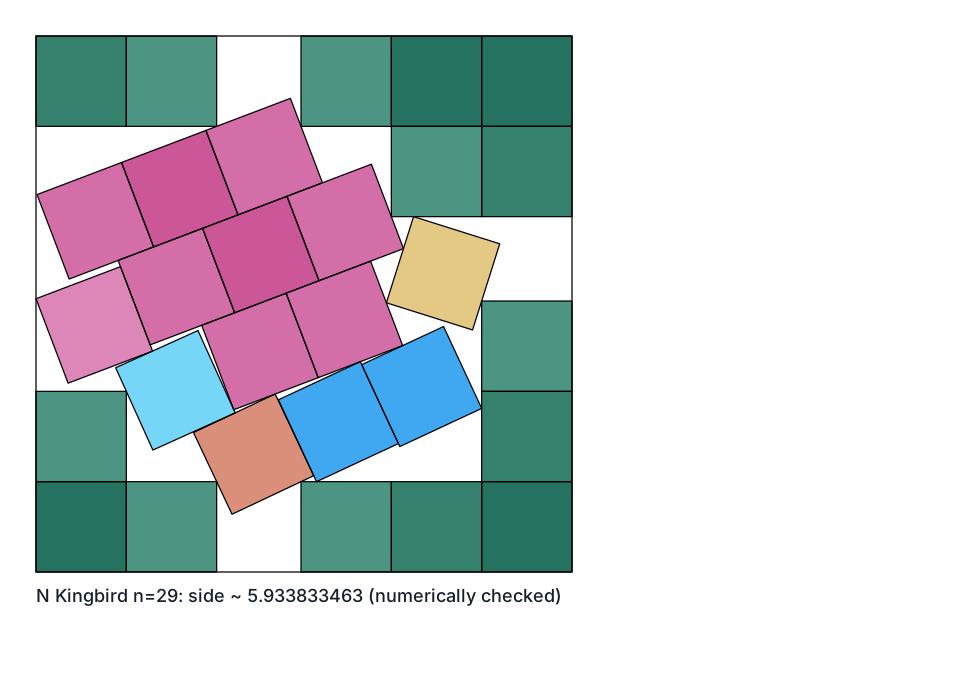
The document-ready view evaluates the retained roughly 100-digit numerical source at 160 decimal digits of working precision and tolerance .
The analytic characterization
This case has no minimal polynomial anywhere — in the literature or here — which is why
exact_form, algebraic_degree and minimal_polynomial are all null.
It does not follow that nothing exact is known.
The retained SVG publishes a complete closed system, and that system is the
characterization: nine slide scalars r1, r2, r3, r4, r5, r8, rB, rC, rD, each given in
closed form, and six equations f1 … f6 in the six unknowns
. 's reported value is the root of that system
near .
The six unknowns are together with the five tilted orientation classes; the sixth
class is the axis class, which holds fifteen squares at zero degrees.
cases.kingbird29.verify_svg transcribes every
scalar and every equation, and uses them to check residuals at the serialized pose.
Solving that same transcription, rather than only evaluating it, was done on 2026-08-28
as a design-discussion measurement — recorded in
X-004, which spends no
experiment budget and asserts no verdict.
It is not yet an in-repository capability: verify_svg still only evaluates.
Turning it into one is
agenda-005’s
BC-047, whose entry condition names this transcription and which is ready for that
reason. The measurement:
| Quantity | Value |
|---|---|
| at 60 digits | |
| Agreement with the reported | all 15 published digits |
| Maximum equation residual at 420 digits | |
| Maximum equation residual at 1200 digits | |
| Wall-clock for a 420-digit solve | about 2 seconds |
The solved angles agree with the orientation classes below — which are derived
independently, from the parsed <use> transforms rather than from the equations — to
every digit compared.
Two separate readings of the same source therefore agree.
This does not move any bound. A high-precision root is not a certificate: no
outward-rounded interval and no exact algebraic form is produced, so
verified_upper_bound remains the Schadt rational and the gap to the reported
record stands. What the solve does establish is that precision at this is available
to any depth on demand, which is a precondition for an exact promotion rather than the
promotion itself. See X-004.
Six Numerically Checked Orientation Classes
Exp-012 first reconstructed all 29 squares from the retained SVG, checked all 406 pairs numerically at 160 decimal digits and tolerance , and replayed the source’s nine derived offsets and six defining equations. The orientations are , , , , , and modulo quarter turns. Exp-037 repeats that check under H-042’s explicitly numerical criterion and rejects its three-class bound. H-024 remains formally unresolved because the SVG supplies no exact or rigorous feasibility certificate.
The check is deliberately described as high-precision numerical reconstruction.
The SVG serializes a FindRoot solution rather than supplying an interval or symbolic
certificate, so this does not independently certify exactness or optimality of the
record value.
What the Schadt repository establishes
Thomas Schadt’s 2025 repository reports the earlier construction as valid at 300 decimal digits with tolerance . Replaying its complete 29-square input through the generic witness tool reproduces that numerical acceptance. It also exposes why this is not formal: 13 pairs have slightly negative best separation, with the worst about , inside the checker’s tolerance. The source checker also accepts an incomplete file, so its output alone does not establish the quantified 29-square claim.
The generic promotion command, run at its default --rational-digits 36, rationalizes
the orientations, adds an explicit side relaxation of about , and writes a
complete rational-corner witness.
A separate exact checker, sharing no geometry code with the promoter, verifies all 29
unit squares, all 406 pairs, and the container constraints.
This proves the formal upper bound shown above.
It remains weaker than the newer Kingbird report, and neither construction says anything
about global optimality.
The lower bound
The superseded external report, [Friedman DS7], gives the lower-bound expression for (approximately ). Friedman’s DS7 survey, Theorem 10, k=5, reports this bound at n=28; reference [8] is Green’s private communication (2000). The source proof has not been recovered. Inherited at n=29 by monotonicity. Tokoharu’s later owned the reported source field and was the verified lower bound, after the complete interval replay and exact premise checks, until wand125’s replayed rectangle-density certificate superseded it on 2026-10-02. The historical source audit compares Green’s exact theorem expression separately from opaque table decimals.
The replay uses the retained source coverage implementation. A method-distinct coverage implementation would add confidence and improve native support for future rectangle-density certificates, but it is not a missing premise of this fixed bound.
Corrected 2 October 2026: Nagamochi’s Lemma 1 is false (Karakuş 2026), so his closed form below is now a reported bound whose published proof is incomplete (review). This register had recorded that proof as verified, its own error, logged as defect D-516. Nagamochi’s earlier general closed form remains part of the evidence history and applies to every :
Verification Code
The programs behind this case’s verified bounds, by their evidence.
The code column says how the code that ran stands to the code its producer used.
VERIFIERS.md says what each program is and whose it is.
| bound | evidence | run | code | programs |
|---|---|---|---|---|
| verified lower | E-n029-wand125-mixed-581-sqverify-fast-replay |
replayed here | independent | V-sqverify-fast (first-party) |
| verified upper | E-n029-interval-certified-upper |
replayed here | independent | V-sqpack-verify (first-party) |