n = 11 proved ★O=R
Proven
- new result
- optimal
- exact
- rigid
Citation record n-011
lowerQueuingtheorydotcom after Levy et al. 2026, Web (confirmed T-060)
upperTrump 1979, Squares in Squares (confirmed T-011)
Bounds
3.87708359…
3.87708359002281- Found by
- Walter Trump 1979
- Construction
- hand, catalogue rigid
- Tilt angles
- ,
- Minimal polynomial, degree 8
- Source
- [Kingbird]
- Evidence
E-kingbird-upper-register,E-n011-trump-upper
3.87708359…
3.87708359002281417730789706010096The reported value, verified here.
- Evidence
E-n011-trump-upper
3.87708359…
3.87708359002281- Proved by
- Queuingtheorydotcom 2026
- Kind
- counting
- Scope
- Unrestricted independent rotations with disjoint interiors; boundary contact allowed.
- Note
- T-060 is the source's global equality, announced as Astra-assisted work building on Squares Project and Kleddamag. Counting here includes a closed center cover and finite pattern enumeration; the conclusion also requires geometric exclusions, exact symmetry and complete local capture. The published cached audits contain four stale final-state digests, so the public RUN_ALL route does not verify those cached receipts. This repository instead independently replayed the pinned source inputs and composed the exact obligations; T-060 stands at V3/C3/S5 on that evidence, machine-checked with its review record pending (it held V4/C5 until the ladder change of 2026-09-30). The source defines T=(6u+4)/(1+2u-u^2), where u is the unique root in (9/25,37/100) of 5u^8-10u^7-2u^6+14u^5+12u^4-6u^3+2u^2+2u-1. Rounded display digits do not define the exact endpoint. Kleddamag's strict remains the earlier, separately verified T-037 bound, and Wang and Li's strict (T-061, Zenodo 23038546) a later historical bound, V3/C3 on its own replays by two machine methods.
- Source
- [Queuingtheorydotcom n11 optimality 2026]
- Evidence
E-n011-global-optimality-report
3.87708359…
3.87708359002281417730789706010096The reported value, verified here.
0
Solved: the verified bounds meet.
Results in the register
T-007 V0 C1 Nagamochi · 2026-08-31 · 321 cases
for
T-010 V3 C3 Levy after Stromquist · 2026-08-31 · n = 11
, by a repair of Stromquist 2003's Figure 14 point set
Claim and records
- Claim
- , by a source-distinct repair of Stromquist 2003's Figure 14 point set: the replacement G' = (79/100, 37/20) restores the complete Figure 13 localization, A-triple forcing, repaired unavoidability, and 3+9 capacity chain, certified exactly. The printed argument does not close (exp-016) and is not relied on.
- Next rung
- V4 and C4 need two adversarial AI reviews by distinct reviewers and a human oversight record, and none is retained. A second independent mechanism, the pose-space interval audit built for T-001 run at side 2 + 4/sqrt(5) over the repaired twelve-point set, would be shown beside the rung. Rung 5 needs a proof-assistant formalization reviewed by human experts.
- Significance
- Resolves the proof status of the subject's flagship case: the lower bound was stated in 1979 and cited as proved since, its printed argument was falsified here, and this restores it with a source-distinct repair.
- Novelty
- apparently-novel Not found in the recorded search, subject to its stated gaps
- Records
T-011 V3 C3 Trump · 2026-08-31 · n = 11
Trump's 1979 packing is exactly valid, so
Claim and records
- Claim
- Trump's 1979 packing is exactly valid: 11 unit squares in a square of side the published degree-8 algebraic number 3.877083590022814..., with 14 of 55 pairs in exact zero-separation contact and 20 corner coordinates exactly on the boundary, so <= that side.
- Next rung
- V4 and C4 need two adversarial AI reviews by distinct reviewers and a human oversight record, and none is retained. A second independent exact verification of the same degree-8 witness would be shown beside the rung (the retained rational control proves a slightly weaker side and does not confirm this claim). Rung 5 needs a proof-assistant formalization reviewed by human experts.
- Significance
- Confirms the record witness exactly, deciding the 14 zero-gap contacts no finite numerical evaluation can: real and citable, changing no theorem.
- Novelty
- previously-published Present in an identified source
- Records
T-018 V3 C3 Levy after Burns, Massaccesi · 2026-09-04 · n = 11
Claim and records
- Claim
- , by this project's weighted fractional unavoidable-set certificate at container side 381/100 = 3.81. This improves Stromquist's 2 + 4/sqrt(5) = 3.788854..., stated in 1984 (Memo III, p. 10) and published in 2003.
No intervening improvement was found by the recorded search, and was then the smallest open case. The movement was +0.021146, and the case stayed open against Trump's 1979 packing at 3.877084: the interval narrowed from 0.088230 to 0.067084. Two rungs are retained below it -- 19/5, the value that first passed Stromquist, and the 189/50 calibration rung below him. - Composition
- Primary: one certificate, one verifier, one accepted verdict. The bound is the certificate's container side directly, with no monotonicity or composition step. It raises no other case: every n > 11 already carries a larger verified bound.
- Next rung
- A second machine method decides it, the interval-certified decision, which is independent in method and, deciding coverage on the doubled net, never invokes the D4 reflection and so does not need Condition 1 at all. One adversarial AI review is retained, PR 78's, ported here as a dated record on 2026-09-05; V4 and C4 need a second adversarial AI review by a distinct reviewer and a human oversight record. An outside mathematical review and an archival release would strengthen the priority record without changing this rung.
The bound itself: 3.81 converged with margin -- objective 10.8603 against eleven, rationalised to 434547/40000 = 10.863675 -- so the next rung is a search question rather than a limit of the method. Getting there took two attempts at the same side, and the difference between them is worth keeping. The first stopped with its row loop still finding violated placements (final least 0.9764) and was refused by the exact sweep at directions 55 to 63, least cell 199531/200000. The second ran the loop to convergence -- three row rounds, 25318 rows, final oracle least mass exactly 1 -- and was accepted at every direction. An objective below n proves nothing on its own; the loop's stopping condition is the thing to read.
Where it stops: 3.82 was then attacked from both sides and neither route closes. The covering LP was run on two independent site sets, and the two stop at exactly eleven for different reasons, which is worth separating because only one of them converged.
The grid-built set, 6637 sites and 14820 rows at the end, ran its row loop to convergence and finished at an objective of exactly 11.000000, descending to it from 11.6 over twelve rounds and never crossing below.
The set seeded from this certificate's own 1121 atoms, 24069 sites, has not converged and does not need to. Its objective has stood at 11.000000 through twenty-four row rounds and 30240 rows while the loop's least covered mass climbed from 0.8490 towards 1, reaching 0.9997 at the round the run was stopped -- so violated placements remained and the loop had not exhausted. Adding rows can only raise a restricted optimum, so the optimum for that site set is at least eleven whatever the loop does next, and no certificate exists on it. Reading the objective alone would have understated this: the loop's stopping state is what makes the conclusion independent of finishing.
A certificate needs mass strictly below eleven, so neither site set yields one. The rejection route does not close either, and it is much further from closing than the search's own progress figures suggest. H-061's object was built and decided exactly: the converged dual is 76 squares, 608 after the D4 images, with a raw total of exactly 11, and sqpack.fractional.ceiling checked all 1650944 vertices of their arrangement, 272244 of them in exact arithmetic. The maximum pointwise depth is 1925/1152 = 1.671007, so the feasible total -- the raw total scaled to make the family a packing -- is 1152/175 = 6.5829 against the eleven a ceiling needs.
The gap between that and the search's running estimate is the thing to carry forward. Column generation prices against a grid sample and reported a depth of 12/11 = 1.0909, which would have made the feasible total 121/12 = 10.08. The exact maximum is 53 per cent higher, because depth peaks at vertices of the arrangement that no grid samples. A ceiling must therefore be judged on the exact check and never on the sampled depth, which flatters it.
One thing 3.82 is not: the method's ceiling. A certificate for n cannot exist above ceil(sqrt(n)) * B, because a wider container holds ceil(sqrt(n))^2 pairwise disjoint axis-parallel B-squares whose masses Condition 5 forces past n; for that is 4B = 3.9908, leaving 0.1808 of runway above the retained 381/100. The wall at 3.82 is a covering wall, met far below where the method stops working.
If tau*(3.82) is exactly eleven then this is the one configuration where neither pre-registered route can close, since a certificate needs mass below n and a ceiling needs the scaled dual to reach n, and both fail by an infinitesimal at exactly n. That is a limit on the reach of the rejection route rather than a stalled search. It is recorded as measurement: two LP runs agreeing to six decimals is evidence about the restricted optima, not a proof that tau* equals eleven, and nothing here rules out a site set neither run found. - Significance
- Scored against the rubric's own anchor for S5, "movement on a central open case". is the smallest open case and a central one for this project; the recorded public search found no movement beyond Stromquist's value, stated in 1984 and published in 2003, and this displaces a bound from the refereed literature rather than an inherited or closed-form one.
What S5 does not claim: the weighted-resource lineage predates this project and the pure-atomic direction-net architecture follows Burns and Massaccesi, so what is new is an instance and the generator that found it; apparent novelty is not absolute priority; and the remaining gap to Trump's 1979 packing is 0.067, which this approach does not close. The calibration rung at 189/50, below Stromquist's bound, was run first by design and is retained. - Novelty
- apparently-novel Not found in the recorded search, subject to its stated gaps
- Records
T-022 V3 C3 Levy after Burns, Massaccesi · 2026-09-06 · n = 11
Claim and records
- Claim
- *sqrt(8100042893309449)/899996306539 = 3.810025723614703, proved by an exact dilation-limit corollary of T-018's retained certificate. For every positive rational q with q^2 below 810004289330944900000000/809993351783841654158521, common scaling preserves the source hypotheses other than containment, and the exact sharpened containment lemma rules out a packing at side qL. Rational density and upward embedding exclude every real side below the supremum, which proves the displayed lower bound. The direct certificate family covers strict rational sides below the supremum; the density-and-embedding step supplies the exact
>=conclusion at the supremum. - Composition
- Derived from a full replay of T-018's accepted five-condition source, scaling equivariance for Condition 1, invariance of Conditions 2 and 3, inverse-dilation preservation of Condition 5, and a separate sharpened containment lemma proved by an exact rational-square comparison. Rational density and upward embedding then supply the limit step. The mapped, non-superseded source-distinct review independently re-derived the theorem and attacked the endpoint, frozen-Condition-4, compactness, scale, and byte-trust boundaries. It is one adversarial AI review, by an agent of this project, and not a human oversight record, so the result is C3; nor is the review a method-distinct second derivation.
- Next rung
- V4 and C4 need a second adversarial AI review by a distinct reviewer and a human oversight record beside the mapped 2026-09-06 source-distinct review. A second, method-distinct derivation would be shown beside the rung and would not improve the bound. This dilation limit is only the uniform fixed-B, single-core strict-containment supremum. Direction-specific cores, two-core endpoint averaging, or exact fixed-atom core shrinkage might extract more from the same data; the present argument does not establish greater than the displayed bound.
- Significance
- The rubric's S5 anchor is movement on a central open case, and this raises the proved lower bound for the smallest open case by about 0.0000257236147034 beyond T-018. The movement derives from an exact support identity and unused strictness margin in an existing certificate; it is not a new certificate architecture and leaves a gap of about 0.0670578664 to Trump's packing.
- Novelty
- apparently-novel Not found in the recorded search, subject to its stated gaps
- Records
T-023 V3 C3 Levy · 2026-09-08 · n = 11
Conditional exclusion: no eleven-square packing in the four-owner branch at
Claim and records
- Claim
- At q = 96/25, if four distinct unit squares have selected strict cores of side B = 9977/10000 containing, respectively, the four closed rational patches in arms.endpoint.footprint_union of the retained exp143 receipt, at most five further unit squares fit. Thus the specified four-owner branch contains no eleven-square packing. The five saved rational dots meet every admissible remaining core on the complete 361-direction net; audited containment and boundary arguments transfer this exact check to arbitrary physical angles. This is a conditional exclusion and changes no global bound for .
- Composition
- Exact full-net coverage and frozen-data identities are machine-checked and replayed here. Universal owner footprint containment, extension to event boundaries, and strict-core selection for physical squares are audited analytic proof steps, so the composed theorem is V3. Exp145 adds an independent inclusion-exclusion computation of the same finite cover. The analytic owner and physical-angle transfer premises remain shared, and the composed theorem is C3; C4 would need two adversarial AI reviews by distinct reviewers and a human oversight record.
- Next rung
- Exp145 completes the independent finite-union check. Assemble a review packet for the shared analytic premises before revisiting confirmation. V4 for the whole theorem requires mechanizing the analytic transfer, and with C4 two adversarial AI reviews by distinct reviewers and a human oversight record.
Exp146 enlarged twelve wall-aware footprints, but exp147 transferred no additional tuple. Exp149 refuted the selected five-dot extension and exp150 showed its escape survives individual owner-core constraints. Exp151 also refuted a fixed sixth-site extension. Exp152 found a nonempty two-core site region, but exp153 then refuted the entire fixed-D-plus-one-site family with 188 exact support directions.
Next audit a short actual-core obstruction and determine whether it is a disjoint pair or only a higher-order obstruction before drawing weighted-mass conclusions. Wider owner-class coverage remains a new research result, not a rung change. - Significance
- A substantive case exclusion at a central open size, demonstrating that forced occupied area can make a five-dot counting argument sufficient. It excludes one owner combination and does not move the global bound.
- Novelty
- apparently-novel Not found in the recorded search, subject to its stated gaps
- Records
T-024 V3 C3 Levy after Burns, Massaccesi · 2026-09-09 · n = 11
Claim and records
- Claim
- *sqrt(518400042893309449)/598960960743657 = 3.816609502788862, proved by an exact dilation-limit corollary of T-018's retained atoms re-certified on a finer direction net.
The 1121 atoms of the retained 381/100 certificate, on the same D4-symmetric sites and with every weight multiplied by 200000/198931, form a certificate of the retained form at side 381/100 on the 1440-step net with shrunken side 2494953/2500000, decided from its frozen bytes by the exact event-cell sweep and by the interval branch and bound, which agree at least cell mass exactly 1.
For every positive rational q with q^2 below 3240000268083184056250000000000/3228788092454681596330191602841, common scaling preserves the source hypotheses other than containment, and the exact sharpened containment lemma rules out a packing at side q times 381/100. Rational density and upward embedding exclude every real side below the supremum, which proves the displayed lower bound. The direct certificate family covers strict rational sides below the supremum; the density-and-embedding step supplies the exact>=conclusion at the supremum. - Composition
- Derived from a full replay of the 1440-step source certificate's five conditions, scaling equivariance for Condition 1, invariance of Conditions 2 and 3, inverse-dilation preservation of Condition 5, and the sharpened containment lemma T-022 proved by an exact rational-square comparison; rational density and upward embedding supply the limit step.
The source certificate is decided by two distinct machine methods, the exact event-cell sweep and the interval branch and bound on its frozen bytes. The load-bearing dilation-limit step has one exact-algebraic decision. Both are machine-replayed here, so the whole result is C3 under the derived-claim minimum rule. No review has been mapped for this result.
The 720-step certificate retained beside it is the rung the standalone reader also decides; its own limit, 38100000*sqrt(129600042893309449)/3594594251080001, is registered as evidence and is weaker. - Next rung
- V4 and C4 need two adversarial AI reviews by distinct reviewers, of the corollary and the two frozen certificates, and a human oversight record. A method-distinct decision of the corollary itself, rather than a second decision of only the source certificate, would be shown beside the rung; T-022's review covered the argument at the 181-step net and this result reuses it unchanged with new B and D.
The standalone reader verify_claim.py decides the 720-step rung and refuses the 1440-step rung by its declared 1000-direction ceiling; a new reader release that lifts the ceiling would let a stranger decide the registered rung without trusting this project, and that is a change to a retained verifier rather than to the mathematics. The shrink is a 10^-7 grid crossing, not a minimum, so a smaller passing shrink off the grid would move the endpoint by less than the grid step.
Two limits are measured on the frozen atoms: at the original shrink the same atoms fail every finer net at an intermediate direction, so the gain is entirely the shrink the finer net admits, and the exact ceiling family at 191/50 caps every one-body point certificate at unit side 3.8288 on any net containing its six directions.
The next movement is therefore a re-optimised certificate at a finer net (H-153), which the covering LP on the frozen sites already shows to be below eleven at 720 steps, and past the cap the threshold atoms of H-152. The displayed lower bound is proved by a dilation-limit argument rather than one individual-side certificate at the algebraic value. - Significance
- The rubric's S5 anchor is movement on a central open case, and this raises the proved lower bound for the smallest open case by about 0.0065838 beyond T-022 and by about 0.0066095 beyond the T-018 certificate side, for about 0.0277551 beyond Stromquist in total. The movement comes from the shrink that a finer net admits under Condition 4, measured on the frozen T-018 atoms; it is not a new certificate architecture, no atom was re-optimised, and the gap to Trump's packing is still about 0.0604741. The same measurement shows where this route ends: the exact depth-one ceiling family at 191/50 caps every one-body point certificate at unit side 3.8288, and these certificates sit about 0.011 below it.
- Novelty
- apparently-novel Not found in the recorded search, subject to its stated gaps
- Records
n = 11registerevidence 1evidence 2evidence 3evidence 4evidence 5source
T-025 V3 C3 Levy · 2026-09-09 · n = 11
, by a threshold certificate
Claim and records
- Claim
- = 3.82, by a threshold certificate: 584 point atoms of mass 271052551/31250000 and 320 threshold atoms, every one 2-of-3, of budget 143352577/62500000, on the D4-symmetric site set at shrunken side 9977/10000 and the 181-direction net.
A threshold atom (S, k, w) charges w to every admissible core holding at least k points of S and costs w floor(|S| / k) of the budget, so the family's total budget is 685457679/62500000 = 10.967322864, strictly below 11, while every event cell at every net direction carries charge at least 100000203/100000000. The counting argument then rules out eleven unit squares with pairwise disjoint interiors in a container of side 191/50. - Composition
- One certificate, decided twice. The certificate is instantiated at its named side, 191/50; no dilation family is part of T-025.
Conditions 1, 1', 2', 3 and 4 are closed-form consequences of the frozen bytes and were recomputed without sqpack in the review; Condition 5' is decided by the exact event-cell sweep of sqpack.fractional.threshold, whose dense-grid and slab evaluations agree at every direction and whose witness charge is re-evaluated by membership counting, and independently by the interval branch and bound of sqpack.fractional.threshold_interval over the doubled net, which never invokes the D4 argument.
The two share the loader, the conditions and the net, and no part of how Condition 5' is decided; the gate refuses the record unless both accept and agree on the least charge exactly.
The result is C3 on those two machine routes. One adversarial AI review of the theorem is retained and mapped, by an agent of this project; it found no soundness defect, and its open items -- the second route, the controls, and a stranger-facing statement in a case directory -- this registration closes. It is not a human oversight record. - Next rung
- Push the side with the same loop: the LP that produced these atoms is run again at a larger side, and the ceiling family says the answer cannot come from point atoms alone on the stated core domain. The finer-net and dilation continuation has now been measured and registered as T-026, proving by an exact dilation-limit argument. That is a separate corollary. T-025 itself proves the ordinary lower bound at V3/C3, and its certificate is instantiated at that named side; V4 and C4 need a second adversarial AI review by a distinct reviewer and a human oversight record. The self-contained T-025 claim embeds its standard-library verifier and certificate bytes. T-025 needs no limit argument, so no dilation record belongs at this rung.
- Significance
- The rubric's S5 anchor is movement on a central open case, and this raises the proved lower bound for the smallest open case by 0.0033905 beyond T-024 and by 0.0311456 beyond Stromquist, leaving the interval [3.82, 3.877084] and a gap of 0.057084. What earns the score beyond the arithmetic is the architecture: the exact depth-one ceiling family retained at this same side proves that no D4-symmetric point-atom measure of mass below eleven exists here, so no certificate of the earlier one-body form could have reached it, and the threshold atoms carry 2.293641 of this budget that the point method cannot have. It is the first certificate of a new kind in this project, decided from frozen bytes by two routes and reviewed adversarially before registration.
- Novelty
- apparently-novel Not found in the recorded search, subject to its stated gaps
- Records
T-026 V3 C3 Levy · 2026-09-09 · n = 11
Claim and records
- Claim
- *sqrt(518400042893309449)/179696714646249 = 3.826447410572939, proved by an exact dilation-limit corollary of T-025's threshold certificate re-certified on a finer direction net.
The 584 point atoms and 320 threshold atoms of the retained 191/50 threshold certificate, on the same D4-symmetric sites and with every weight multiplied by 500000000/498684619, form a threshold certificate of the retained form at side 191/50 on the 1440-step net with shrunken side 249507/250000, decided from its frozen bytes by the exact event-cell sweep and by the interval branch and bound, which agree at least cell charge exactly 1. The rescaled total budget is 5483661432/498684619 = 10.996251384, still strictly below eleven.
For every positive rational q with q^2 below 32400002680831840562500000000/32290909254655439869209770001, common scaling of the point atoms, the threshold atoms' points, the container side and the shrunken side preserves the source hypotheses other than containment, and the exact sharpened containment lemma rules out a packing at side q times 191/50. Rational density and upward embedding exclude every real side below the supremum, which proves the displayed lower bound. The direct certificate family covers strict rational sides below the supremum; the density-and-embedding step supplies the exact>=conclusion at the supremum. - Composition
- Derived from a full replay of the 1440-step threshold source's Conditions 1, 1', 2', 3, 4 and 5' by the threshold theorem's own exact sweep, scaling equivariance for Conditions 1 and 1', invariance of Conditions 2' and 3, inverse-dilation preservation of Condition 5', and the sharpened containment lemma T-022 proved by an exact rational-square comparison; rational density and upward embedding supply the limit step.
The confirmation rests on the two machine decisions of the source certificate, which fail differently: the exact event-cell sweep of sqpack.fractional.threshold, whose dense-grid and slab evaluations must agree at every direction, and the interval branch and bound of sqpack.fractional.threshold_interval over the doubled net, which never invokes the D4 argument.
One adversarial AI review is retained and mapped, of the self-contained claim, by a separate agent from the implementation authors; it covers the threshold count, exact sweep, dilation, and endpoint inference. It is not a human oversight record, so the result is C3. T-025's earlier review covers the threshold theorem and T-022's covers the dilation argument; the new review checks their composition with the T-026 values and embedded data.
The 720-step certificate retained beside it crosses at the same shrink and reaches 955000*sqrt(129600042893309449)/89874194646249 = 3.825347845913112, which isolates the remaining 0.0010996 as the effect of D halving alone. - Next rung
- The rescaled 1440-step budget is 5483661432/498684619, leaving 1869377/498684619 below eleven. The measured 720- and 1440-step certificates have the same crossing shrink and least unscaled charge. These finite measurements do not decide another net or prove that frozen-atom refinement cannot improve the limit. Re-certification on another net, re-optimization on a finer net, changed site generation, and richer charge atoms remain distinct hypotheses. The retained plateau duals with depth above one are useful separation inputs but not globally feasible obstruction witnesses.
The self-contained T-026 claim embeds the standard-library threshold verifier, the 1440-step certificate, and the exact dilation record; its mapped source-distinct review is the one adversarial AI review retained. V4 and C4 need a second adversarial AI review by a distinct reviewer and a human oversight record; rung 5 would require a proof-assistant formalization reviewed by human experts. - Significance
- The rubric's S5 anchor is movement on a central open case, and this raises the proved lower bound for the smallest open case by about 0.0064474 beyond T-025's 191/50 and by about 0.0375930 beyond Stromquist's 2 + 4/sqrt(5), leaving the interval [3.826447410572939, 3.877084] and a bound gap of about 0.0506362.
The movement is the shrink a finer net admits under Condition 4, measured on the frozen T-025 atoms; no atom was re-optimised and no new theorem was needed, since Conditions 1, 1', 2' and 3 are untouched by common scaling and Condition 5' is preserved by inverse dilation of placements exactly as Condition 5 is.
For this fixed certificate, the rescaled budget is 5483661432/498684619 = 10.996251384 against the eleven a certificate may not reach, leaving about 0.0037 of budget. The measured 720- and 1440-step nets share the same crossing shrink and least unscaled charge. These finite measurements leave the effect of another net, a different core side, re-optimized weights, changed sites, and richer charge atoms unresolved. - Novelty
- apparently-novel Not found in the recorded search, subject to its stated gaps
- Records
n = 11registerevidence 1evidence 2evidence 3evidence 4evidence 5source
T-031 V3 C3 Levy · 2026-09-20 · n = 11
The octagon corner class (threshold ) holds no eleven-square packing at side
Claim and records
- Claim
- At L = 96/25 and B = 9977/10000 on the 181-direction net (half-tangents k*207107/90000000, k = 0..180), the D4-symmetric point measure of total mass 10868617/1000000 = 10.868617 in cases/n11_corner_class_certificate/certificate.json, the retained exp-220 covering, charges at least 2000013/2000000 to every closed B-square at a net direction whose minimum of x + y is at least 1/2 in each of the four corner frames, decided by the exact event-cell sweep and by the interval branch and bound, which agree at that value.
Consequently every packing of eleven unit squares in [0, 96/25]^2 contains a unit square whose minimum of x + y in some corner frame is strictly below 1/2, that is, one that meets the open corner triangle x + y < 1/2 at that corner; equivalently, the all-free (octagon) class of lane-a Theorem B at threshold 1/2 contains no eleven-square packing at side 96/25.
This is a conditional exclusion of one corner-bin class and changes no bound on ; the all-deep class is separately known to be outside this language's reach (BC-366), so the corner tree cannot close at 96/25 by clipping alone. - Composition
- The certificate is a weighted fractional unavoidable-set certificate of the retained form whose row domain is the D4-symmetric convex clip of the admissible core domain by the four corner triangles at depth 1/2, admitted as a domain predicate on the row generator and threaded through both gate routes and the ceiling readers in Session 145 with a residual-7 control on the transported 88-family.
The declared C3 is what the two cited atoms derive. The exact event-cell sweep and the interval branch and bound are the two internal routes of one decide_certificate --corner-clip 1/2 invocation, which refuses the file unless both accept: they share the Certificate parser and the closed-form conditions, carry a byte-identical replay string, and the exact leg records relationship_to_generator: same-implementation, so the repository counts the pair as one confirmation and not as two method-distinct derivations. The Session 146 registration review says exactly that; a genuinely separate derivation of this clipped decision would be a second machine method, and none exists.
The verification rests on the two machine decisions of the frozen bytes, which fail differently: the exact event-cell sweep with the clip as extra half-planes on the per-slab centre range, and the interval branch and bound whose boxes are dropped only when provably inside the excluded set; the two decide the same set only because the clip is D4-invariant and folded, which the instrument's tests check. Conditions 1 to 4 are decided exactly before either route runs.
The conclusion transfers from the shrunken cores to the unit squares without loss in the direction that matters, because the kept domain is closed and a core lies strictly inside its square by Condition 4. The retained bytes declare variant class and the clip, and the gate refuses them without the flag, so the file cannot be read as a bound. - Next rung
- The complementary class, in which some core meets a corner triangle, is the hard one: the all-deep class is a Lemma-D theorem for every site set (the transported 88-family keeps residual 7 against a requirement of 7, BC-366), so no point covering excludes it and the corner tree cannot make 96/25 unconditional by clipping. The four mixed D4 classes (fourteen bin vectors) are a bounded follow-up under BC-367 and need a box cut on the row domain. The instrument that could matter is a 2-of-3 threshold atom on ring-centre overlaps inside the all-deep class, which needs the clip wired into the threshold routes.
V4 and C4 need two adversarial AI reviews by distinct reviewers and a human oversight record, and none is retained: the Session 146 registration review is not mapped under docs/project/reviews. The case directory and the gate control test in the T-022 pattern are retained. - Significance
- The first decided item of the corner-conditioned point language at a central open size: one D4 class of the corner tree is excluded at 3.84 by a certificate on a clipped domain, with the structural consequence that every eleven-square packing in a square of side 96/25 has a square meeting an open corner triangle of depth 1/2. It moves no bound, and the registration review shows the tree it belongs to cannot close at this side in the point language alone, since the all-deep class is a Lemma-D theorem for every site set (BC-366); the mixed classes are a bounded follow-up.
- Novelty
- apparently-novel Not found in the recorded search, subject to its stated gaps
- Records
T-033 V3 C3 Levy · 2026-09-22 · n = 11
Claim and records
- Claim
- *sqrt(2073600042893309449)/359341754646249 = 3.826997548829543624, proved by an exact dilation-limit corollary of T-025's threshold certificate re-certified on the 2880-step direction net.
The 584 point atoms and 320 threshold atoms of the retained 191/50 threshold certificate, on the same D4-symmetric sites and with every weight multiplied by 500000000/498684619, form a threshold certificate of the retained form at side 191/50 on the 2880-step net with shrunken side 249507/250000, decided from its frozen bytes by the exact event-cell sweep and by the interval branch and bound, which agree at least cell charge exactly 1. The rescaled total budget is 5483661432/498684619 = 10.996251384, still strictly below eleven.
The shrink is T-026's and does not move under refinement; what this net changes is the largest half-gap tangent, 207107/1440000000 over the 2881 directions of the net, exactly half the 1440-step value, and the bound rises with it.
For every positive rational q with q^2 below 129600002680831840562500000000/129126496632245014779129770001, common scaling of the point atoms, the threshold atoms' points, the container side and the shrunken side preserves the source hypotheses other than containment, and the exact sharpened containment lemma rules out a packing at side q times 191/50. Rational density and upward embedding exclude every real side below the supremum, which proves the displayed lower bound. The direct certificate family covers strict rational sides below the supremum; the density-and-embedding step supplies the exact>=conclusion at the supremum.
What that conclusion does not carry is stated with it. No individual certificate is supplied at the supremum, because the sharpened containment test is equality there; no strict inequality is established there; and 191/50 remains the largest side at which the retained T-025/T-026/T-033 fixed-core family holds an individual-side certificate, which is T-025's and not this result's. - Composition
- Derived from a full replay of the 2880-step threshold source's Conditions 1, 1', 2', 3, 4 and 5' by the threshold theorem's own exact sweep, scaling equivariance for Conditions 1 and 1', invariance of Conditions 2' and 3, inverse-dilation preservation of Condition 5', and the sharpened containment lemma T-022 proved by an exact rational comparison of squares; rational density and upward embedding supply the limit step.
The source certificate's own acceptance rests on two machine decisions of one frozen file that fail differently, the exact event-cell sweep of sqpack.fractional.threshold, whose dense-grid and slab evaluations must agree at every direction, and the interval branch and bound of sqpack.fractional.threshold_interval over the doubled net, which never invokes the D4 argument.
The derived bound does not inherit that. The dilation step on top of them is decided by one exact-algebraic entry and by nothing else, and epistemics.md takes a derived claim to the minimum over its inputs and the derivation itself, and the derivation is machine-replayed here like its inputs, so the rung is C3. T-022 read its own case the same way. This reconciliation applies the same rule to T-024, whose earlier declaration counted only the source certificate's two routes.
A method-distinct decision of the corollary itself, an interval enclosure of the strict factor test and of c squared recorded as its own interval-certified entry, not the source's two routes, would give the derivation a second machine method. No review has been mapped, so rung 4, which needs two adversarial AI reviews by distinct reviewers and a human oversight record, is not in reach.
The step is T-022's argument reused unchanged, at the same B and a halved D, whose proof note is cited here rather than rewritten. T-026's 1440-step rung is the control at the coarser net -- the same atoms, the same weights and the same crossing shrink, the two records differing in direction_steps, in their id and provenance, and in no other field -- and the refinement run reproduced its registered surd exactly, so the 0.000550138 between the two rungs is the halving of D alone. - Next rung
- V4 and C4 need two adversarial AI reviews by distinct reviewers, of this corollary and the frozen 2880-step certificate, each a document under docs/project/reviews/ entered in docs/project/document-map.yaml with role review, and a human oversight record. A method-distinct decision of the corollary itself would be shown beside the rung. T-026's mapped review is scoped to the 1440-step claim and reviewing that one is not reviewing this one, so it is not cited here.
No self-contained verifiable-claim document is rendered for this rung either: devtools.render_verifiable_claim carries one branch per retained threshold claim and its T-026 branch is bound to that rung's witness direction, surd and proof note, so a third rung needs the branch parameterised and a proof note of its own.
The rescaled budget is 5483661432/498684619, leaving 1869377/498684619 below eleven, and the side this rung reaches is within about 0.000550 of 955000/249507, which is all that any further refinement of the net can buy while the shrink stands where it does. Refinement is therefore near exhausted on these atoms, and re-optimization at a finer net, changed site generation and richer charge atoms remain distinct hypotheses rather than a continuation of this one. A further assurance step would require proof-assistant formalization, external review, or an independently reproduced full decision. - Significance
- This is a substantive controlled case result and machine audit of this project's retained threshold family. It moves T-026 from 3.826447410572939744 to 3.826997548829543624 by halving D inside T-022's sharpened containment factor sqrt(1 + D^2)/(B(1 + D)), at T-026's own crossing shrink, which does not rise under refinement; Condition 4's own coarse test B(1 + D) < 1 has the lower ceiling 152800000000000/39926861627361 = 3.826997509248, which this value exceeds. The sharpened factor is what reaches; no atom was re-optimised and no new theorem was needed, since Conditions 1, 1', 2' and 3 are untouched by common scaling and Condition 5' is preserved by inverse dilation of placements exactly as Condition 5 is.
The certificate is the same measure T-026 registered: the rescaled budget is unchanged at 5483661432/498684619 = 10.996251384, still strictly below the eleven a certificate may not reach, and only the net and the half-gap tangent differ.
The unchanged family cannot reach the stronger current verified bound 31/8: its refinement ceiling 955000/249507 is about 3.82755, already below 3.875. The result therefore records controlled method and calibration evidence, rather than a current public-bound advance. Changed weights, sites, parent domains, and richer charge atoms remain unresolved. - Novelty
- apparently-novel Not found in the recorded search, subject to its stated gaps
- Records
n = 11registerevidence 1evidence 2evidence 3evidence 4evidence 5source
T-035 V3 C3 Levy · 2026-09-24 · n = 11
Six-plus-five packings near Trump's tilt with side lie within
rhoof his poseClaim and records
- Claim
- Every packing of eleven unit squares in a square container, six at orientation 0 and five sharing one orientation modulo pi/2 with half-tangent in [91442076901/250000000000, 73154061521/200000000000] (an interval containing [t* - 10^-6, t* + 10^-6] for Trump's exact half-tangent t* = 0.365769307604677...), whose side is at most the rational U_hi of the certificate header (U_hi - U = 2.03e-45), lies, after the quarter turn that puts its tilted centroid in the closed upper-right quadrant and the relabelling that orders each class by x + y/4, strictly within rho = 808514697/200000000000 of Trump's labelled image (rotation 1, labels [3,4,2,5,0,1,8,10,6,9,7]) in every centre coordinate, with every tilted orientation within 2.0e-6 radians of Trump's; every other packing in the family has side greater than U_hi.
The statement is a machine-verified reduction, not optimality: a closed exact cell tree of 139,441,005 records, replayed in full by an independent reader, puts every small packing in the family near Trump's pose. It does not invoke the BC-240 local theorem. T-036 composes it with that theorem's first clause. - Composition
- Not compound. One certificate tree and one reader verdict carry the whole statement, with no local theorem, monotonicity or composition step between them. The reader closes a Trump-degenerate leaf by exact arithmetic, bounding every centre coordinate of the cell's packings within rho of the labelled image, which is why the statement stops at the rho-ball rather than at Trump's pose. The entry is C3 (repository-origin, exact-algebraic, a certificate, a replay and a passing status). One adversarial AI review is retained, the mapped 2026-09-24 closed-tree review: a Fable max W2 review by a different agent than the lanes that produced the tree, inside the same project. It is not an external review and not a human oversight record.
- Next rung
- V4 and C4 need a second adversarial AI review by a distinct reviewer and a human oversight record; rung 5 would need a proof-assistant formalization of the cell-tree contract and its reader, reviewed by human experts. Three steps would strengthen the record without moving a rung. The certificate could be retained where a gate can reach it; until then the manifest is the record's only hold on it. The reader could compare the declared box with t* +- 10^-6 itself, a comparison only the review has made. A reader that accepts a non-root cell would make the negative control reader-checked. The mathematics beyond this result is rung 1 of the ladder, H-112, which H-242's pilot (BC-383) prices: a per-node bound that closes this box in far fewer than 1.7e8 nodes comes before more boxes.
- Significance
- A substantive case result and machine audit at the smallest open case: one certificate tree, closed with no unresolved leaf, reduces a whole restricted family to a neighbourhood of Trump's pose. It moves no bound on , its family is one box of half-tangents 2e-6 wide, and its cost, about 1.7e8 nodes for that one box, argues against S4's reusable technique. The 2026-09-24 closed-tree review scored the composed theorem S3 on the same grounds.
- Novelty
- apparently-novel Not found in the recorded search, subject to its stated gaps
- Records
T-036 V3 C2 Levy · 2026-09-24 · n = 11
Trump's pose is optimal among six-plus-five packings near its tilt, unique up to symmetry
Claim and records
- Claim
- Every packing of eleven unit squares in a square container, six at orientation 0 and five sharing one orientation modulo pi/2 with half-tangent in [91442076901/250000000000, 73154061521/200000000000] (an interval containing [t* - 10^-6, t* + 10^-6] for Trump's exact half-tangent t*), has container side at least U = 3.877083590022814..., the exact side of Trump's packing, and a packing in the family has side exactly U only if it is a quarter-turn image of Trump's pose with the squares relabelled within the two classes.
Reflections leave the family, since they send the tilt theta* to pi/2 - theta*, whose half-tangent 0.464 is outside the box, so that Z/4 x S6 x S5 orbit is the whole equality set. The statement is T-035's reduction composed with the first clause of the BC-240 local theorem at Trump's pose. It says nothing about any other tilt, about packings whose orientation classes are not six plus five, or about . - Composition
- Compound, and the minimum is set by BC-240's first clause. The reduction, T-035 on E-n011-h236-rung0-reduction, is V3/C3. The first clause, on E-n011-trump-local-theorem-first-clause, is an audited proof whose steps are prose and whose radius computation alone is machine-checked, so method proof-audited with a proof block supports V3 and nothing higher, which fixes the composed theorem at V3. The checker derives C3 from the reduction's entry; this note is why the declared confirmation is C2.
The composing step is the one the closed-tree review derived again: undoing the quarter turn carries a Trump-degenerate leaf's packing at side s' <= U to a translate by (0, U - s') inside [0,U]^2, a sup-norm isometry on centre differences, so the first clause forces Trump's labelled pose and the four wall contacts force s' = U. The angle window, 2.0e-6 radians, is below rho_row.
Confirmation is C2 by the C table: the clause's replay command, the source-distinct BC-241 checker, passes at this head, and a proof-audited entry does not derive above C2.
2026-10-02: the radius generator gained a replay mode, so rho_row = 808514697/200000000000 now carries an exact-algebraic entry of its own, E-n011-trump-isolation-radius (replayed-here, same-implementation, passed), and C3 for the radius is derived. It does not set the composed theorem's minimum, because the closed-tree review's question, whether BC-240's audited prose steps are load-bearing for confirmation, is answered yes.
The replay and the BC-241 checker confirm the quantities the proof consumes (the moduli, the curvature constants, the stresses, the caps and their aggregate arithmetic) and not the steps that use them. Those steps are prose, and the first clause rests on each: that the second-order remainder of every active function is at most K/2 times the squared norm, so that the modulus forces the norm to be at least 2 kappa/K; that every packing in the ball selects one of the 128 branches, which needs the inactive-feature gap cap, itself a single-source computation; and the composing step through the quarter turn.
A mutation or a perturbed radius is refused by the replay, but a wrong prose step would not be. So C2 stands until those steps are mechanised or reviewed again by a distinct reviewer with the oversight record the ladder asks for. - Next rung
- The replay mode the closed-tree review asked for exists, and the radius has its own exact-algebraic entry, but the composition note judges BC-240's audited prose steps load-bearing, so C3 needs those steps mechanised or reviewed again by a distinct reviewer, not more replay of the radius. V4 would need BC-240's closing steps mechanised rather than only the quantities they consume, and with C4 a second adversarial AI review by a distinct reviewer and a human oversight record. Retaining the per-face dual witnesses and recomputing the gap cap from distinct source are the closure review's two bounded residual tasks.
- Significance
- A substantive case result and machine audit: the first optimality statement with an equality case for a family containing Trump's packing. Stromquist 2003's bound for squares at 0 and 45 degrees is an earlier restricted-orientation statement, and it is not attained and its family does not contain Trump's packing. It moves no bound on , and its cost, about 1.7e8 nodes for one box, argues against S4's reusable technique.
- Novelty
- apparently-novel Not found in the recorded search, subject to its stated gaps
- Records
T-037 V3 C3 Kleddamag after Levy, Guzhou0806, Mira · 2026-09-29 · n = 11
Claim and records
- Claim
- = 3.875, by Kleddamag's 11-squares-certified-bound v1.0.2 release of 22 September 2026. It raised the case's verified lower bound by 0.048002 over T-033 and leaves 0.0020836 to Trump's 3.8770835900.
The certificate is an exact nonnegative D4-invariant system of point and k-of-m threshold charges over 12,028 contiguous parent-angle intervals, each with a closed core strictly inside every parent of the interval, parents of side 764/775 in a container of side 191/50. Eleven disjoint cores would carry at least 11 x 999962528 against a budget of 10999479944, which they exceed by 107864 integer units, and compactness makes the bound strict.
It was replayed here in full by the source's two exact event-cell sweeps, in Python and JavaScript, and decided a second time by this repository's native parent-core interval branch and bound (devtools.verify_kleddamag_n11_native), which accepted all 12,028 rows with no stalled box.
Kleddamag, 11-squares-certified-bound, building on Squares Project (Joshua Levy): the release's ATTRIBUTION.md says the work builds on this project and that global-certificate.json was developed from T-026's certificate. - Composition
- Primary at : one certificate and the bound L/A, with no monotonicity step. Two evidence entries whose methods differ both passed on the retained certificate, which is C3 with the two methods shown beside the rung: the source's exact event-cell sweeps (exact-algebraic, replayed here; the Python and JavaScript scanners are one method) and this repository's directed-rounding interval coverage of every row (interval-certified). Both rest on the source's certificate and on the same counting and transfer theorem, which the two 2026-09-22 reviews read.
- Next rung
- V4 and C4 need two adversarial AI reviews by distinct reviewers of the complete claim and a human oversight record. The two 2026-09-22 reviews are mapped and each reads one route; neither is recorded in this entry's reviews, and whether a same-project review of another author's certificate qualifies is the owner's decision rather than missing work. Rung 5 needs a proof-assistant formalization of the transfer theorem and the counting argument, reviewed by human experts. Superseded on 2026-09-29 by Wang and Li's (T-061), which is this certificate reweighted and scaled, 3.9e-9 higher, and by T-060's exact = T; stays true as stated.
- Significance
- Scored at S5 by the rubric's anchor, movement on a central open case. is a central open case of this project, and T-019 gave not being one as its first reason for staying below S5. The bound closes about 96 per cent of the gap the register held, from 0.0501 to 0.0021 below Trump's packing, and it is this project's T-026 certificate adopted and carried further outside it. The mathematics is Kleddamag's; this repository's part is the replay and the method-distinct second decision.
- Novelty
- previously-published Present in an identified source
- Records
n = 11registerevidence 1evidence 2evidence 3source 1source 2review 1review 2
T-047 V3 C3 Tokoharu after Levy, wand125, Stromquist, Nagamochi, Burns, Massaccesi · 2026-09-29 · 7 cases
; for ; for
T-058 V3 C3 wand125 after Tokoharu, Daniel · 2026-09-29 · 100 cases
Rectangle-certificate ceiling
α·UB(n)proved for ..100;B·UB(n)on 64 grid rowsT-059 V3 C3 wand125 after Tokoharu, Daniel · 2026-09-29 · n = 11
Reported equality of 12028 n11 row minima reproduced by a complete bound replay
Claim and records
- Claim
- wand125/square-packing-tools reports that its exact general_pose_tree checker reproduces all 12028 per-row core minima of Kleddamag's n11 certificate, release v1.0.2, with global row minimum 999962528 units and all witnesses replayed. This is the source's row-scan equality claim only, not a new proof of the global counting theorem or independent rectangle-density coverage.
wand125, square-packing-tools, 29 September 2026, building on Tokoharu's rectangle method, solver and verifier and on Evan Daniel's point verifier. The source discloses Codex and Claude assistance. - Next rung
- V4 and C4 need a second, independent row-minimum method (the checker and the claim share one implementation, so no method diversity is claimed) and the review record the ladder requires. A separate branch-and-bound over the 12,028 rows is the natural second method; the existing native parent-core branch and bound already decides the same rows for the counting premise (T-037).
- Significance
- A reusable independent row-checking implementation worth replaying; the existing n11 bound does not change.
- Novelty
- previously-published Present in an identified source
- Records
T-060 V3 C3 Queuingtheorydotcom after Levy, Kleddamag · 2026-09-29 · n = 11
Trump's eleven-square packing is globally optimal
Claim and records
- Claim
- , where is the unique root in of . Independent rotations and boundary contact are allowed.
The proof, published by Queuingtheorydotcom on 29 September 2026, is confirmed here by a re-implementation sharing components with the source -- complete repository geometric executions on kernels the source also bundles -- and a mapped mathematical audit.
Queuingtheorydotcom, 11SquaresOptimal, Astra-assisted work building on Squares Project and Kleddamag. The matching construction is Trump's. - Composition
- The complete 2184-pattern cover and 2180 exclusions leave four symmetric survivors. The D4 bridge reduces these to case 438; the 14-round root induction and complete 10-node capture graph eliminate all far branches and force the near state into the reviewed local region. Exact local isolation and the endpoint embedding argument exclude every side below . The exact Trump witness attains . All premises have completed exact executions, which is V3/C3. One adversarial AI review is retained and mapped, by GPT-6 Astra at max reasoning; it is not a human oversight record. No second machine method is claimed.
The Lean 4 formalization in 11SquaresFormalized states the whole claim as one theorem,ElevenSquare.optimality, which the 6 October statement audit reads as this claim with the same exact . Its source reports that its full verification run, resumed from earlier validated receipts, passed with an axiom audit that trusts Lean's compiler for 13,308native_decideaxioms. That run is private and recorded as reported, so it sets no rung; the build here covers the statement closure and the upper half only. - Next rung
- V5 needs two records the register lacks. One is a complete build of the 11SquaresFormalized proof that the record can rest on, with its axiom receipt: run here from the retained pin at its toolchain, or a third party's build retained here. The source's own run is private and is recorded as reported (E-n011-lean-formalization-report). The other is a retained formalization review by a named human expert who is not its author and states competence in Lean and in the mathematics, checking statement fidelity, the definitions, the axioms (the 13,308
native_decideaxioms the theorem trusts to Lean's compiler among them) and that build.
V4 and C4 need the owner's oversight record and a second adversarial AI review by a reviewer distinct from Astra. C5 needs that build made here at the pinned toolchain, anopen_reviewpointer and two such expert reviews. Engineering follow-up think-e2ot will orchestrate fresh whole-ensemble replay through reviewed state-equivalence bindings. Simplification was to precede the n11 explainer, tracked separately, which is now the eleven-square optimality paper. - Significance
- Resolves global optimality for , a central case, by closing the gap to Trump's exact construction, beyond the previous strict T-037 lower bound.
- Novelty
- previously-published Present in an identified source
- Records
n = 11registerevidence 1evidence 2evidence 3source 1source 2review 1review 2
T-061 V3 C3 Wang, Li after Kleddamag, Levy · 2026-09-30 · n = 11
, 3.9e-9 above
Claim and records
- Claim
- = 3.875000003875000003875..., by Ke Wang and Can Li's Zenodo record of 29 September 2026, reported on jlevy/squares#247. The step over 31/8 is exactly 31/7999999992, about 3.9e-9.
The certificate is Kleddamag's v1.0.2 global-certificate.json (T-037) with thirteen threshold-charge orbits raised, which puts the minimum core charge at 1000047559 on every one of the 12,028 parent-angle intervals, and with the parent and every core side scaled by 999999999/1000000000, so that the container over the parent is (31/8) times 1000000000/999999999. Eleven disjoint cores exceed the budget 11000095024 by 428125 integer units.
One more step of the scale factor, 1 - 2*10^-9, already fails at row 615, so these data admit at most about twice the step. Scaling Kleddamag's certificate alone already passes a full sweep, so the reweighting enlarges the surplus but is not needed for the bound.
It was replayed here in full by the authors' two verifiers and by Kleddamag's own Python and JavaScript event-cell sweeps, and decided a second time by this repository's native parent-core interval branch and bound, which accepted all 12,028 rows with no stalled box.
Ke Wang and Can Li, Zenodo record 23038546, building on Kleddamag and this project. The record makes no statement about AI assistance. - Composition
- Primary at : one certificate and the bound L/A', with no monotonicity step. Two evidence entries whose methods differ both passed on the retained certificate, which is C3 with the two methods shown beside the rung: the event-cell sweeps (exact-algebraic: the authors' primary, Kleddamag's Python and JavaScript, and the authors' re-implementation are one method) and this repository's directed-rounding interval coverage of every row (interval-certified). Both rest on the certificate and on T-037's counting and transfer theorem, whose hypotheses were re-checked at the scaled sides.
- Next rung
- V4 and C4 need two adversarial AI reviews by distinct reviewers of the complete claim and a human oversight record; the 2026-09-30 review is a same-project read and is not recorded in this entry's reviews. Rung 5 needs a proof-assistant formalization of the transfer theorem and the counting argument, reviewed by human experts. The reweighting is not needed for the bound: Kleddamag's own weights at the scaled sides pass Kleddamag's full event-cell sweep with the same minimum 999962528 and surplus 107864 (the packet's scale-only receipt), so the scaling alone carries the step and the thirteen raised orbits only enlarge the surplus to 428125.
- Significance
- It strictly raises the verified lower bound at a central case, which the S5 anchor names, but by 31/7999999992, about 3.9e-9, spending the slack of T-037's certificate after a reweighting; the release itself calls it a proof-of-slack result, and these data admit at most about twice the step. The case's gap to Trump's packing, 0.0020836, does not change at any printed digit, so it is scored as a citable detail rather than movement; T-042 is the precedent for scoring a true, fully replayed step by what it changes.
- Novelty
- previously-published Present in an identified source
- Records
n = 11registerevidence 1evidence 2evidence 3source 1source 2review
T-083 V3 C3 Karakuş · 2026-10-02 · 301 cases
for every nonsquare
T-085 V3 C3 Karakuş; chelokot · 2026-10-02 · 315 cases
Nagamochi 2005, Lemma 1 is false for every container with and
T-112 V3 C2 Levy after Queuingtheorydotcom · 2026-10-06 · n = 11
Trump's packing is the only optimal packing of eleven squares, up to symmetry
Claim and records
- Claim
- Every packing of eleven unit squares in a square of side T = 3.8770835900228141773…, the least side T-060 proves possible, is Walter Trump's 1979 packing after one of the eight symmetries of the container and a relabelling of the squares. Independent rotations and boundary contact are allowed. A quarter-turn reparametrization of one square is the same physical square and does not count as another packing. No symmetry of the container maps Trump's packing to itself, so there are exactly eight optimal packings as unlabelled configurations, the images of one another.
This is a direct corollary of T-060 and adds no computation. T-060's proof embeds any packing of side S <= T concentrically in the rational cap U > T, where its 2,180 exclusions, the D4 reduction to case 438, the closed capture partition and pose inclusion all apply, and maps it rigidly into the fixed side-T frame, where the local isolation lemma forces the exact construction. For S < T the construction's span T is a contradiction, which is T-060. For S = T nothing is contradicted: the packing is the construction after the alignment, a D4 element composed with the case-438 quarter turn, which is this result.
It is T-036's equality clause without T-036's restriction to six squares at angle 0 and five near Trump's tilt, and with reflections, which leave that family. - Composition
- One entry, E-n011-optimum-uniqueness, proof-audited, which cites the completed exact executions of E-n011-global-optimality-independent unchanged and adds one prose step, that every premise of T-060's endpoint is stated for side S <= T and at S = T yields the construction rather than a contradiction. Proof-audited with a proof block supports V3. The step is prose and not mechanised, so the declared confirmation is C2, as for T-036's composing step, though every quantity it consumes is T-060's and re-implemented sharing named components.
T-060's evidence, E-n011-global-optimality-independent, is a premise of the entry and is not cited here beside it: it claims the exact value, which would give this result a bound's standing that it does not have. - Next rung
- C3 needs the step at S = T mechanised, or reviewed again by a distinct reviewer with the oversight record the ladder asks for. The Lean theorem ElevenSquare.optimality in 11SquaresFormalized, whose statement the project's audit of 6 October reads as = T, states the lower bound and the construction and no equality case; a Lean statement of the equality case would be the route to rung 5, once a formalization is reviewed here. Rung 4 needs what T-060's rung 4 needs: the owner's oversight record and a second adversarial review of the global chain.
- Significance
- A substantive case result: it completes the classification at eleven squares, the optimum being a single rigid packing up to symmetry, with no sliding family and no second contact type at T, in the case T-060 settled. It moves no bound and adds no method, since it is T-060's argument read at equality, which is what an S4 would need; it is one step above T-036's restricted equality case.
- Novelty
- apparently-novel Not found in the recorded search, subject to its stated gaps
- Records
upper: replayed here; lower: audited here
—
locally rigid, verified, exact algebraic
Evidence: E-n011-trump-local-rigidity
Scope
First order at the exact fixed-side pose, in open real orientation charts: all 128 derivative-distinct branchwise one-sided linearized cones are the zero cone, and a finite-branch subsequence argument upgrades that to local isolation and strict local side optimality in the anchored pose-side chart. No neighborhood radius is quantified by this certificate, and nothing here bears on global optimality. A quantified radius does exist elsewhere in the record and is not registered here: the BC-240 packet at cases/trump11/isolation-theorem.md states a sup-norm radius of at least 808514697/200000000000 and a quadratic side constant of at most 2574612531/200000000, which the source-distinct BC-241 review accepted on 2026-09-06 and a full radius-generator replay on 2026-09-24 reproduced value-for-value on all 128 branches, with the weighted modulus confirmed on all 8,448 faces by the method-distinct capture_radius control; the first clause is verified, exact, with per-face dual witnesses recomputed rather than retained (docs/project/reviews/review-2026-09-24-bc241-closure.md).
46 evidence entries
E-n011-global-optimality-report, E-n011-global-optimality-independent, E-n011-lean-formalization-report, E-n011-lean-statement-closure-build, E-n011-wang-li-report, E-n011-wang-li-source-replay, E-n011-wang-li-native-parent-core, E-n011-kleddamag-3875-report, E-n011-kleddamag-3875-source-replay, E-n011-kleddamag-3875-native-parent-core, E-wand125-tools-n11-row-report, E-wand125-tools-n11-row-replay, E-tokoharu-density-report, E-tokoharu-density-source-replay, E-kingbird-upper-register, E-n011-trump-upper, E-n011-repaired-lower, E-n011-trump-local-rigidity, E-n011-fractional-certificate, E-n011-fractional-dilation-limit, E-n011-fractional-net1440-certificate, E-n011-fractional-net1440-interval-decision, E-n011-fractional-net1440-dilation-limit, E-n011-fractional-net720-certificate, E-n011-fractional-net720-dilation-limit, E-n011-threshold-certificate, E-n011-threshold-interval-decision, E-n011-threshold-net720-certificate, E-n011-threshold-net720-dilation-limit, E-n011-threshold-net1440-certificate, E-n011-threshold-net1440-interval-decision, E-n011-threshold-net1440-dilation-limit, E-n011-threshold-net2880-certificate, E-n011-threshold-net2880-interval-decision, E-n011-threshold-net2880-dilation-limit, E-n011-five-dot-full-net, E-n011-five-dot-independent-union, E-n011-five-dot-physical-transfer, E-n011-wall-owner-footprints, E-n011-wall-owner-containment, E-n011-corner-class-96-25-exact-decision, E-n011-corner-class-96-25-interval-decision, E-n011-h236-rung0-reduction, E-n011-trump-local-theorem-first-clause, E-n011-trump-isolation-radius, E-n011-optimum-uniqueness
- [Queuingtheorydotcom n11 optimality 2026] lower bound proof
- [Wang Li n11 2026] lower bound proof
- [Kleddamag n11 2026] lower bound proof
- [Tokoharu density 2026] lower bound proof
- [Kingbird] record catalogue
- [Stromquist 2003] lower bound proof
- [Ellsworth SVG] numerical witness
- [Gensane–Ryckelynck 2005] numerical witness
- [Friedman DS7] survey
— solved
Verified exact value, 2026-09-30. , the side of Walter Trump’s 1979
packing: , where
is the unique root in of .
The exact witness gives the upper bound (T-011); independent exact replay
of Queuingtheorydotcom/11SquaresOptimal’s proof inputs gives the matching unrestricted
lower bound (T-060, V3/C3/S5: machine-checked, review record pending).
The proof review and
retained evidence identify the
shared mathematical dependencies and the four stale digests in the publisher’s cached
audits. This verifies global optimality.
Unique, 2026-10-06. T-112 registers the corollary that follows
directly from T-060: its endpoint argument covers a packing of side exactly as well
as a smaller one, and there it forces Trump’s construction, so every optimal packing is
Trump’s after one of the eight symmetries of the container and a relabelling of the
squares (V3/C2/S3; the step at side is prose and adds no computation).
No earlier source found states it:
Trump’s 2023 note and
Friedman’s survey
call the packing rigid, a local property, and the
upstream proof
states uniqueness only within its case 438. At ten squares
Stromquist
gives three different optimal packings, so a solved count need not have a unique
optimum.
Explained in Papers I, II and III, one series read in order: Part I (T-018, T-025 and T-026), Part II (T-037) and Part III (T-060).
Lean formalization, 2026-10-06. The whole claim is one Lean 4 theorem,
ElevenSquare.optimality in
Queuingtheorydotcom/11SquaresFormalized,
whose author, Queuingtheorydotcom, posts on X as
@ManassehA06 and announced the
formalization there on 6 October 2026: the optimality “has been formalized in lean
thanks to Astra and Claude”.
The owner quoted that post the same
day with the formalization’s context, calling it “a Lean formalization from @ManassehA06
assembled over the last few days, with assistance from @ctjlewis @guzhou0806 and
others”. The
statement audit
reads its statement as exactly over this record’s model: closed unit squares
with independent rotations, boundary contact allowed and open interiors disjoint.
The source reports that its full verification run, in a private repository and resumed
from earlier validated receipts, passed with its final axiom audit; by that audit the
theorem rests on Lean’s three standard axioms and on 13,308 native_decide axioms, so
it trusts Lean’s compiler as well as its kernel.
It is recorded as the source’s report on T-060 (E-n011-lean-formalization-report,
packet) and moves
no rung. The full build was not repeated here; the 18 modules that define the statement
and Trump’s packing at side were, on the standard axioms alone
(E-n011-lean-statement-closure-build). No complete build this record can rest on, and
no human expert’s review of the formalization, is retained yet.
Historical lower bound, 2026-09-30. Ke Wang and Can Li’s certificate (Zenodo
23038546, 29 September 2026, T-061) proves
, above . It
is Kleddamag’s certificate below with thirteen threshold-charge orbits raised, which
lifts the minimum core charge to 1,000,047,559 on every interval, and with the parent
and every core side scaled by ; eleven cores then exceed the
budget 11,000,095,024 by 428,125 units.
The step is slack spent rather than new structure: the scale factor
already fails at row 615, so these data give at most about twice the step.
Kleddamag’s own weights, scaled the same way and not reweighted, also pass a full sweep,
so the reweighting is not needed for the bound
(receipt). The
authors’ two verifiers and Kleddamag’s own Python and JavaScript sweeps pass on the
retained certificate, and this repository’s native interval coverage accepts all 12,028
rows, so the bound stands at V3/C3 on two machine methods, a strict bound that T-060’s
equality supersedes.
The packet is
wang-li-n11-2026-09-29, and the
mathematical review
re-derives every hypothesis at the scaled sides.
The release makes no statement about AI assistance; on jlevy/squares#247 the authors
wrote that “AI assistance was used for most of the computational exploration, code
drafting and checking, organization of verification outputs, and preparation of the
written materials.”
Earlier verified lower bound, 2026-09-22. Kleddamag’s pinned v1.0.2 certificate
proves . Both complete exact source sweeps passed locally across
all 12,028 parent-angle intervals, with minimum charge 999,962,528 units and total
budget 10,999,479,944 units: eleven cores exceed that budget by 107,864 units.
The complete source, proof dependencies and replay records are retained in the
external certificate packet.
The
mathematical review
checks the threshold budgets, strict core containment, complete centre domains, exact
arithmetic and boundary argument.
The
replay receipt
and
independent audit
support V3/C3 by themselves, as one machine method: the Python and JavaScript scanners
implement the same event-cell method.
The source’s ATTRIBUTION.md says the work builds on Joshua Levy, the squares project,
developing its certificate from this repository’s T-026, that its JavaScript checker
adapts Guzhou0806 / N17 project’s R038 checker, and that it inherits the Levy, Guzhou
and Mira lineage of the work; its AUTHORS.md says Kleddamag commissioned and
directed the research and OpenAI Codex developed the mathematical and computational
continuation.
Session 153’s
complete native decision
independently certifies all 12,028 rows by directed-rounding box coverage and direct
threshold counting.
Every row reaches the exact charge threshold, with zero stalled boxes
and no exhausted budgets or refutations.
The
native mathematical review
checks the full parent-centre domains, strict core containment and the complete transfer
to unit-square packing.
The two complete coverage methods confirm the strict bound at V3/C3, two
methods, with the review record pending.
This confirms Kleddamag’s published bound without a new result identifier.
Tokoharu’s separately replayed rectangle-density bound is numerically weaker.
Tokoharu’s README says parts of the work were produced with AI assistance under human
direction.
The certified interval before T-060 was (T-061), and under T-037 before that. T-060 closes that gap at Trump’s exact algebraic endpoint.
The earlier first-party lower bounds remain in the register as history and method
evidence. T-026’s exact lower bound is
, proved by
an exact dilation-limit argument at V3/C3 (it held V4/C5 until 2026-09-30). T-033
tightens the same retained family to the exact lower bound
at V3/C3;
its certificate was decided by both the exact event-cell sweep and a distinct interval
branch and bound, while the load-bearing dilation step has one exact-algebraic decision.
The external certificate closes 95.89% of the interval between T-026 and Trump’s
construction, the correctly rounded percentage in the supplied post.
The two routes share the certificate data and theorem statement.
For T-033, that pair confirms the source certificate by distinct methods, but the bound
is derived from it by a single exact-algebraic step, and a derived claim takes the
minimum over its parts.
The derivation sets the rung.
No review of that derivation is mapped; T-026’s mapped source-distinct review is scoped
to the 1440-step claim.
The upper construction has stood since 1979. The previous lower bound was Stromquist’s
, stated in
1984, Memo III, p. 10
and published in 2003. On 2026-09-04, a first-party weighted fractional unavoidable-set
certificate at side (T-018) proved that eleven unit squares do
not fit in a container of side . The recorded source search found no intervening
improvement. An exact refinement of the containment step and the resulting strict
rational-dilation family then prove the lower bound
(T-022). On 2026-09-09 the same atoms, re-certified on the 1440-step
direction net at the larger shrink the finer net admits, and dilated by the same
argument, prove the lower bound
(T-024).
T-018’s certificate moved the bound by about ; T-022 adds another , T-024 another , T-025 another , T-026 another , and T-033 another , for total first-party movement of about beyond Stromquist before the stronger external replay recorded above.
One thousand one hundred and twenty-one weighted atoms on a D4-symmetric site set carry
total mass , and every placement of a shrunken square covers mass at least
, the least being ; the certificate is decided from its frozen bytes by an
exact event-cell sweep and by an interval branch and bound that agree on that value to
the digit. Two rungs are retained below it: , the value that first passed
Stromquist, and a calibration rung at , below Stromquist’s bound, where
the same construction proves nothing new; it was run first on purpose, as the diagnostic
registered in advance.
Stromquist’s own value keeps its place in the record: exp-017 supplies the independent
exact certificate for it after exp-016 refuted his printed Figure 14 cover, and that
history is unaffected.
Side was attacked from both sides and neither route closes: two independent site
sets stop at a covering value of exactly eleven, and the rejection route’s exact maximum
depth caps its feasible total at against the eleven a ceiling needs.
That is recorded as measurement, not as a claim about the covering value.
On 2026-09-09 the rejection route closed: an exact depth-one family of eighty-eight
closed -squares at six net directions, of total weight exactly eleven, retained as
campaign/series/series-000-smoke-and-calibration/results/agenda-034/ceiling-family-191-50.json
and decided both by the ceiling verifier and by an independent reader written from the
statement, proves that no D4-symmetric point-atom measure of mass below eleven exists at
for the retained shrink on any net containing those six directions.
The plateau is therefore a theorem about the method, and the recorded restricted optima
of exactly eleven were reading it; scaled to unit squares the same family caps the
one-body point method at unit side .
T-023 excludes one specified four-owner case at side : four guaranteed occupied patches leave a residual domain pierced by five fixed dots, so at most five further squares fit where eleven would require seven. The composed result is V3/C3: an exact complete-net check plus audited geometric transfer to arbitrary physical angles. It does not cover every owner combination and does not change either verified bound. The illustrated report gives the statement, experiments, proof links and ordered continuation.
T-031 excludes the all-free (octagon) corner class at the same side
: a weighted fractional certificate of mass on the row domain
clipped by the four corner triangles charges at least
to every admissible core avoiding them, so every packing of eleven unit squares in a
square of side has a square meeting an open corner triangle at some corner.
Both gate routes decide the frozen bytes (V3/C3: the two routes are one gate invocation,
so they count as one machine method).
The all-deep class is separately outside the point language for every site set, so the
corner tree cannot close at this side by clipping alone; the exclusion changes no bound.
These case exclusions remain historical method evidence.
The new global lower bound already excludes every packing at that side, so closing more
classes there would no longer advance the strongest numerical bound.
The register therefore marks T-031 superseded by T-060, since it
states nothing about packings beyond its exclusion, and T-023 superseded in part: its
count, at most five squares beside the four owners and nine in all, is a statement about
ten squares, which T-060 does not reach.
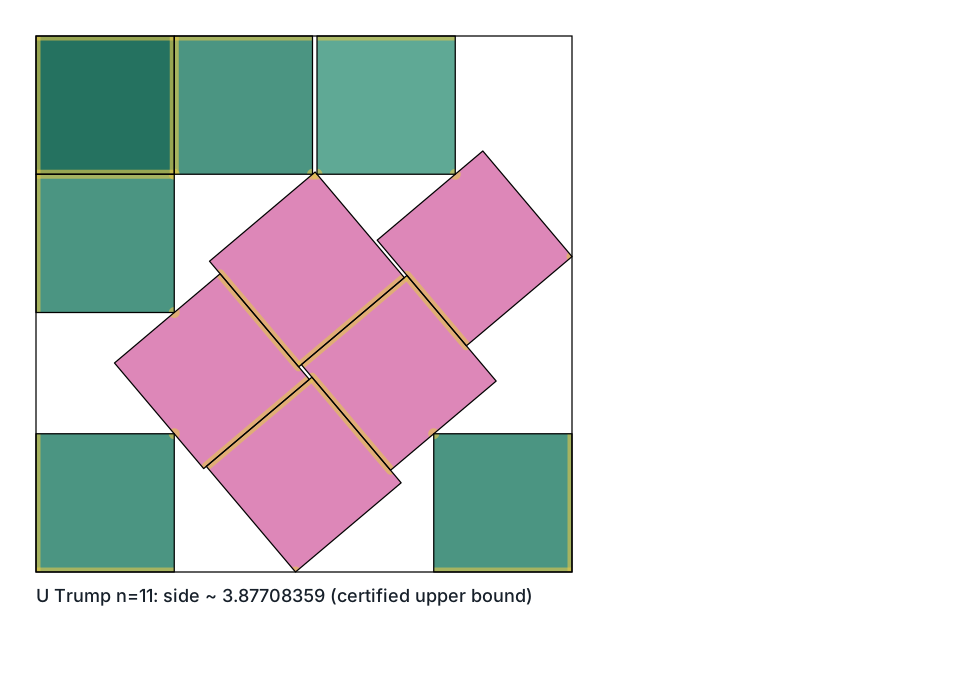
Six axis-aligned squares surround a five-square block at an algebraic tilt near . Segments and dots show exact edge and point contacts. The witness supplies the upper bound; T-060 supplies the matching global lower bound.
Why the former gap was difficult
The best known packing is Walter Trump’s, found in 1979 and reportedly computed on an HP-67 programmable calculator. Six squares are axis-aligned and five form a tightly constrained block tilted at —an angle that is neither 0° nor 45°, which is what makes the case famous. Its contact equations determine the displayed side value, a root of an irreducible degree-8 polynomial over . Exp-013 now supplies an exact qualitative local certificate: every branchwise fixed-side linearized cone is zero, so a finite- branch subsequence argument locally isolates the pose. That local certificate does not supply a numerical isolation radius or the global proof; the latter is the separately verified T-060 result above.
That degree explained why the earlier low-degree approaches were inconclusive. Before T-060, every solved case had of degree ≤ 2, while familiar unavoidable-point arguments produced low-degree thresholds. The corpus contains no theorem bounding the algebraic degree such arguments can certify. A degree-8 target may demand richer geometry, but it does not by itself rule out the method.
What rigidity does and does not buy
A complete local rigidity certificate now controls the packing in some neighborhood.
The tangent-cone computation does not quantify that neighborhood; the separate BC-240
packet does, and its radius is retained rather than registered (see the rigidity scope
above). The exact contact equations make its algebraic value computable, but this local
certificate says nothing about whether a different contact class does better.
T-060’s global exclusion and capture argument supplies that missing step.
Fifty years of search, including a purpose-built inflation/billiard algorithm, has not
found one. Global solvers are not part of that record: no global solver runtime has been
measured here, and the hybrid-strategy review of 2026-09-07 says so in as many words.
That once raised confidence in the conjecture but supplied no proof: a search that fails
to find something better has certified nothing.
Since 2026-09-24 the register also holds a statement about every packing in one
restricted family that contains Trump’s packing.
Freeze the five tilted squares to within of Trump’s tilt in the half-tangent
and keep the other six axis-aligned: T-035 reduces every packing in that
family at side at most to the BC-240 ball around Trump’s labelled pose, by a closed
exact cell tree that an independent reader replayed in full, and T-036
composes it with BC-240’s first clause, so no packing in the family has side below
and only Trump’s pose, up to quarter turns and relabelling, attains it.
It is the first optimality statement with an equality case for a family containing
Trump’s packing; Stromquist’s / bound is an earlier restricted-orientation
statement. It says nothing about any other tilt and moves no bound on ; its
certificate tree is retained outside the record, which keeps a manifest of it.
T-060 has since settled , Trump’s side, which is T-036’s
, and that gives every packing of eleven squares, in the family or not, a side of at
least , so the register marks T-036 superseded in part by it.
Its equality case followed on 6 October 2026: T-112, the uniqueness
corollary of T-060, makes Trump’s packing the only one at up to the container’s
symmetries and relabelling, in the family or not.
Each of the two implies a part of T-036 and together they imply all of it; the
register marks it superseded in part by each, since it has no mark for a supersession
that two results make jointly.
The most misunderstood point in the literature
Stromquist’s 2003 paper is routinely described as having proved Trump’s packing optimal. It did not. It stated a lower bound of , which does not match ; exp-016 also shows that its printed Figure 14 proof is false. Exp-017 independently restores the same lower bound with a source-distinct repaired point set. What Stromquist did prove without that repair was Gardner’s conjecture — that is the first case requiring non-45° orientations — by bounding the 0°/45° class below at and pointing at Trump’s smaller value. A qualitative question resolved while the quantitative optimum stayed open.
Provenance of the exact solution
Distinct from the packing itself, and a second source of confusion. Gensane and Ryckelynck (2005) computed the first exact algebraic characterization, by a 14-equation Maple elimination, publishing the cosine of an angle offset 45° from the standard tilt — verified here to be . Their paper’s claim to have “improved” refers to sharpening the recorded decimal for Trump’s own configuration from to , not to a denser packing. David Ellsworth obtained the reduced degree-8 minimal polynomial in June 2023 and showed two contact equations suffice where fourteen had been used; Boris Alexeev confirmed it independently thirteen hours later by a different method.
Formal results replayed in this repository
The evidence references above keep three questions separate: what a source reports, what
is formal, and what this repository has replayed or audited independently.
The exact separating-axis verification, all 128 linearized-cone certificates, and the
exp-017 repaired lower-bound certificate are reproducible with
uv run --frozen --group dev packing-validate. The 14 pairs that touch with exactly
zero gap are the ones no floating-point checker can certify, which is the practical
reason exact arithmetic is needed at all.
The Exact-Containment Limit Corollary
The retained certificate proves slightly more than its own container side. Dilating every atom position, the container side, and the shrunken side by one factor leaves Conditions 2 and 3 unchanged, carries Condition 1 equivariantly, and preserves Condition 5 through inverse dilation of placements. The frozen theorem bounds the angular support coarsely by . The exact worst-case support factor is , so strict containment after scaling is the rational test . The strict family has factor supremum and side supremum .
Set . T-022 proves that
is a lower bound for . For any real side below it, rational density supplies one
of the strict rational no-fit sides above that candidate; a packing in the smaller
container would embed in that larger one.
This uses the infimum definition of , not compactness or attainment.
The conclusion is the ordinary non-strict lower bound . The direct
certificate family covers strict rational sides below ; the sharpened
containment test is equality at , so the proof does not supply an
individual-side certificate at or establish . The theorem is
the displayed lower bound.
This is the supremum only for uniform fixed- dilation with one concentric core and
strict support containment; stronger use of the same atom or coverage-cell data remains
open. The exact proof, source hash, full five-condition replay, and refusal boundary are
in the
T-022 proof packet.
T-024 applies the same argument to the same atoms on a finer net.
Condition 4 ties the shrink to the net’s largest half-gap tangent , so a finer net
admits a larger shrunken side; the frozen T-018 weights, multiplied by one rational
factor, still cover every closed core on the 1440-step net once the shrink is
, and the resulting certificate at was decided by both routes
of the retention gate.
Its strict dilation family has side supremum
. Rational
density and upward embedding therefore prove the displayed non-strict lower bound.
The proof has no individual-side certificate at that algebraic value.
A 720-step certificate is retained beside it, with its own lower bound, because it is
the rung the standalone reader also decides.
The exact ceiling family at shows that no certificate of this one-body form can
be dilated past unit side , so the route ends about above these
certificates; the proof, the crossing measurements and the replay commands are in the
T-024 proof packet.
The same corollary runs on threshold atoms without a new theorem, which is what T-026
below does with T-025’s. The one thing the argument needs beyond the point case is that
every threshold atom’s points scale with the point atoms: a core’s trace on the scaled
points is the trace of its preimage on the unscaled ones, so Condition 5' survives
inverse dilation for the reason Condition 5 does.
The Threshold Certificate at
T-025 leaves that route rather than extending it, and it is the first certificate here
to pass the point method’s own ceiling.
Beside 584 point atoms it carries 320 threshold atoms: a threshold atom
charges to every admissible core containing at least of the points of , and
because pairwise disjoint cores divide between them, one such atom can charge at
most of them — so of budget pays for it.
Every one of these is -of-, buying two points’ worth of coverage for one point’s
worth of budget. The total budget is , below eleven
with margin ; the least charge over every event cell at every one of the
181 net directions is ; its historical conclusion was
at V3/C3 (it held V4/C5 until 2026-09-30). The finite
certificate is instantiated at its named side, ; no dilation family is part of
T-025. The frozen bytes were decided by the same two-route gate the fractional rungs use
— the exact event-cell sweep and the interval branch and bound — which agree on the
least charge to the digit, and the theorem was attacked in a
source-distinct adversarial review
before the certificate was registered.
The exact ceiling family above is what makes this the only way past for a
certificate of this shape: no D4-symmetric point-atom measure of mass below eleven
exists at this side, and the threshold atoms carry of budget the point method
cannot have. The statement, the counting proof, the frozen premises and the replay
commands are in the
T-025 proof packet.
T-026 put those same atoms on a finer net.
Condition 4 ties the shrink to the net’s largest half-gap tangent , so the 1440-step
net admits a larger shrunken side; the frozen weights, multiplied by the single rational
factor , charge every closed core of side at every
direction of that net, one grid step above the largest shrink at which the
finer net fails. The rescaled budget is , still
below eleven, and both routes of the retention gate return least cell charge exactly
. Dilating that certificate under T-022’s sharpened containment test, then applying
rational density and upward embedding, proved the historical first-party bound
, which T-033 later tightened.
The 720-step rung retained beside it has lower-bound value , so
of that was what halving bought and nothing else.
The proof, crossing measurements, and replay commands are in the
T-026 proof packet.
T-033 turns the same lever once more, and it is the last turn worth much.
The 2880-step net halves again, to over its 2881 directions, and
the crossing shrink does not move: the same frozen atoms at the same weights still
charge every closed core of side , now at every direction of the doubled
net, so the rescaled budget and the least cell charge are T-026’s unchanged and the
two records differ in direction_steps, in their id and provenance, and in no other
field. Both routes of the retention gate accept the frozen bytes and agree at exactly
. The same dilation argument with the new gives the displayed T-033 supremum,
above T-026’s value — half of what the previous doubling bought, which
is what halving alone predicts.
The direct certificate family for T-033 covers strict rational sides below its displayed
supremum; the sharpened containment test is equality there, so the proof supplies no
individual-side certificate at the supremum and establishes no strict inequality there.
The side remains the largest side with an individual-side certificate in the
retained T-025/T-026/T-033 fixed-core family at the time T-033 was registered.
The rescaled budget sits within of the eleven a certificate may not reach, and
the registered side is within of , the ceiling the retained
shrink leaves for any further refinement.
That ceiling is below , the external bound verified on 2026-09-22 as T-037, and
T-060 has since settled , so unchanged-family net refinement cannot improve
the global bound. Changed weights, sites, parent domains, and charge atoms remain
separate hypotheses.
T-033 reuses T-022’s argument unchanged, at the same and a halved , so it has
no proof packet of its own and cites T-026’s; that derivation step is decided by one
entry of one method.
The result is C3, machine-replayed here, and no review of it is mapped.
The frozen bytes, the limit record and the replay commands are in the
case package, and the run that produced them is
in the
exp-226 receipt.
Verification Code
The programs behind this case’s verified bounds, by their evidence.
The code column says how the code that ran stands to the code its producer used.
VERIFIERS.md says what each program is and whose it is.
| bound | evidence | run | code | programs |
|---|---|---|---|---|
| verified lower | E-n011-global-optimality-independent |
audited here | shared components | V-n11-optimality-checkers (first-party); V-check-n11-final-composition (first-party, premises) |
| verified upper | E-n011-trump-upper |
replayed here | independent | V-sqpack-verify (first-party) |